Quick Answer
There is no certification behind the phrase. NHTSA's Chief Counsel told a seat-cover maker in 2011 that no Federal Motor Vehicle Safety Standard applies to aftermarket seat covers, that NHTSA does not approve or certify equipment, that its regulations do not require makers to test covers for compatibility with side airbags, and that it knows of no industry standard for it. The federal make-inoperative rule binds dealers and repair businesses, not owners fitting covers themselves. So the verification is yours: read your manual's restraint section to learn whether that seat has a seat-mounted airbag at all, check the automaker's own position — Toyota's service bulletin advises against aftermarket covers on side-airbag seats outright — and look for a specific design claim on the cover maker's own site rather than a phrase in a listing title.
Key takeaways
- Airbag compatible is a self-declared claim. NHTSA states that no federal standard applies to aftermarket seat covers, that it certifies nothing, and that makers are not required to test compatibility with side airbags.
- The federal make-inoperative prohibition covers manufacturers, dealers and repair shops. It does not reach a vehicle owner fitting covers themselves, which is why the checking falls to you.
- A missing SRS tag is not evidence. NHTSA confirms no standard requires that label to exist, and none restricts a cover from hiding it. The owner's manual is the authority on what your seat contains.
- Toyota's bulletin for side-airbag-equipped 1998 to 2014 models advises against aftermarket covers entirely, and rules out even Toyota's own covers where they were not designed for those seats.
- Of the five sets we list, three makers publish a traceable airbag statement and two do not. FH Group's own FAQ warns that not all of its covers are airbag-designed, so a brand-level yes is not a SKU-level yes.
What to do, by what your seat actually has
| If your situation is… | Pick | Why |
|---|---|---|
| Front seat with a seat-mounted side airbag, and you want it covered | A cover whose maker publishes a release-seam design, fitted exactly as directed | Nothing certifies the claim, so the maker's own published design statement is the strongest evidence available — and it has to name the outboard release path, not just the word compatible. |
| You drive a Toyota built between 1998 and 2014 with optional side airbags | Follow the bulletin and leave the front seats uncovered | Toyota's T-SB-0122-11 strongly advises against installing or using aftermarket seat covers on those seats, and rules out its own covers that were not designed for them. |
| Rear bench, or a vehicle whose side protection is roof-rail curtains only | Choose on fit, grip and material | With no seat-mounted bag there is no deployment path through the seatback, so the airbag question does not apply and a universal set is a reasonable buy. |
| You cannot find an SRS tag and are treating that as an all-clear | Stop and read the manual's restraint section | NHTSA confirms no federal standard requires that tag, so its absence tells you nothing about whether the seat contains an airbag. |
| A shop or dealer is fitting the covers for you | Ask them, in advance, what they check | The make-inoperative prohibition does bind repair businesses, so a fitter has a legal exposure you do not — and that makes them the right person to raise the airbag question with. |
Use this row to shortcut by situation.
Search any retailer for airbag-compatible seat covers and the phrase comes back thousands of times, set in the title like a certification mark. It is not one. The federal agency you would expect to stand behind it has answered that question in writing, twice, and the answer is that nobody is required to check.
Five questions a cover maker asked the regulator
In August 2011 a seat-cover manufacturer wrote to the Chief Counsel of the National Highway Traffic Safety Administration with the questions a careful company would ask before printing a safety claim. The reply is short and unambiguous.
| What the maker asked | What NHTSA answered |
|---|---|
| Is there a federal standard for aftermarket seat covers? | Currently there are no FMVSSs directly applicable to aftermarket seat covers. |
| Does NHTSA certify or test them? | No. The agency does not approve or certify vehicles or items of equipment. |
| Must a maker test its covers against side airbags? | NHTSA regulations do not require manufacturers of seat covers to test their seat covers to see if they are compatible with the side air bags. |
| Is there an industry standard for this? | Our answer is no. |
| May a cover hide the airbag tag on the seat? | Yes. No federal standard requires that tag to exist. |
The letter is not hostile to the products. NHTSA says it believes it is practicable to design a cover that will not affect proper deployment of a side airbag, and that makers have been producing such covers for years. That is a statement about what is achievable, not a finding about the set in your cart.
Read the footnote: the same letter notes that NHTSA prohibits certifying that a product meets the FMVSS when no FMVSS applies to it, and calls such statements confusing and misleading. A cover advertised as meeting a federal safety standard is naming a standard that does not exist for it.
The rule that stops at your driveway
Federal law does restrict this — for everyone except the person most likely to do it. Section 30122 of the Safety Act bars knowingly making a safety device inoperative, and a second interpretation letter sets out exactly who it binds.
Bound by the make-inoperative prohibition:
- Manufacturers, distributors and dealers
- Motor vehicle repair businesses — including a shop that fits covers for you
Not bound by it:
- You, fitting them yourself in your own vehicle
NHTSA states the second half plainly: vehicle owners may install an aftermarket product even if the product negatively affects the safety systems in their vehicles, without violating its regulations. The agency then encourages owners to avoid disabling or reducing the effectiveness of safety features. That encouragement is the entire enforcement mechanism on your side of the transaction, which is why the checks below have to be yours.
One automaker's published answer is simply no
Toyota's technical service bulletin T-SB-0122-11, issued for side-airbag-equipped 1998 to 2014 models and filed with NHTSA, does not hedge. It states that seat covers not recommended by Toyota may affect side airbag performance during an accident, that modifications which negatively affect that performance can result in severe occupant injuries, and that seat covers are an integral part of the safety system. It closes by strongly advising against the installation or use of aftermarket seat covers.
The detail worth pausing on is one line further up: Toyota's own original seat covers, where they were not designed for side-airbag-equipped seats, cannot be used either. The objection is not to aftermarket brands. It is to any cover the seat was not engineered around.
Rule of thumb: where the vehicle manual and the cover packaging disagree, the party that engineered the seat is the one holding deployment data. Check your own manual's airbag section before the product page.
The tag is not the test
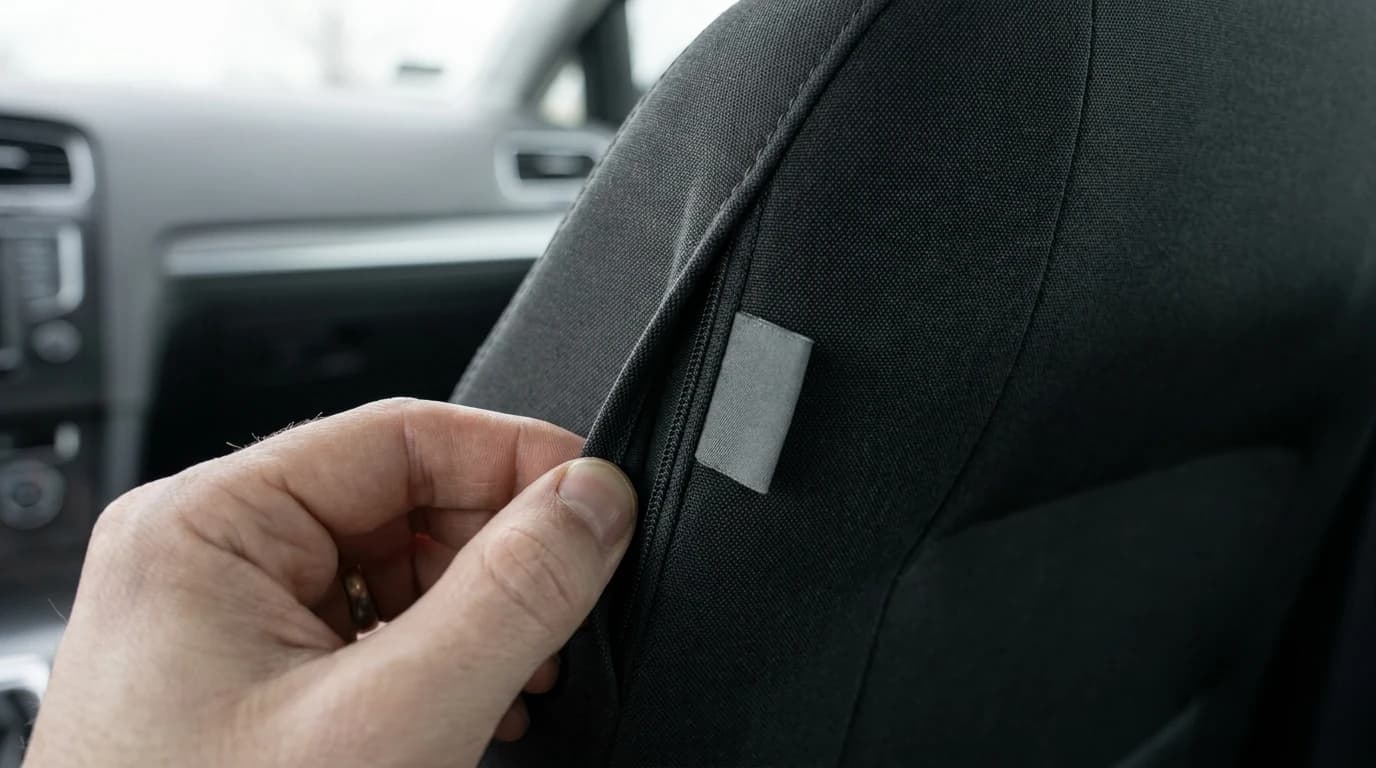
Almost every guide to this tells you to look for an SRS or AIRBAG tag on the outboard side of the seat. It is useful when it is there. It proves nothing when it is not.
NHTSA's 2011 letter addresses the tag directly: its safety standards do not require manufacturers to include a label indicating the presence of a side airbag, the label carries no safety information or warnings, and the agency places no restriction on a seat cover covering it. A seat with no visible tag can still have a seat-mounted airbag behind the bolster, and the only document that settles it is the owner's manual for your model year.
Three checks that survive the marketing
- Confirm what your seat actually has. Read the supplemental restraint section of your manual for the specific seat position — seat-mounted torso bags, roof-rail curtains and combinations of the two all get sold as side airbags, and only the first kind interacts with a cover.
- Read the automaker's own position, not just the cover maker's. Toyota's bulletin is public. Other manufacturers publish their guidance in the manual's seat and restraint pages.
- Look for a specific design claim from the cover maker, in their own words on their own site, naming a release seam or an open outboard panel. A phrase in a marketplace listing title is not a manufacturer statement.
What that test finds across the sets we list
We applied the third check to the five seat cover sets we currently list, on 9 August 2026. Three makers publish an airbag statement we could trace to their own site. Two do not.
| Set | Maker statement we could trace |
|---|---|
| Coverado waterproof leather full set | Yes — Coverado publishes its own guidance describing a release design and SRS-path fitment |
| Aierxuan custom-fit leather, Ford F-Series | Yes — Aierxuan states its covers use side-seam stitching intended to let side airbags deploy |
| FH Group neoprene full set | Yes, with a caveat — see below |
| Motor Trend SpillGuard neoprene full set | None found |
| BDK PolyPro universal cloth set | None found |
The FH Group caveat is the most useful line any of them publishes. Its FAQ answers the side-airbag question with yes, and then immediately adds that not all of its seat covers are designed for that feature, pointing shoppers at a filter. A brand-level yes is not a SKU-level yes, and that distinction is exactly what a listing title erases.
We could not trace a published statement from the other two. That is what we can honestly report — an absence of evidence found, not proof that a claim was never made somewhere we did not look. Their spec rows on this site say the same thing rather than filling the field with a comfortable yes.
When the question does not apply at all
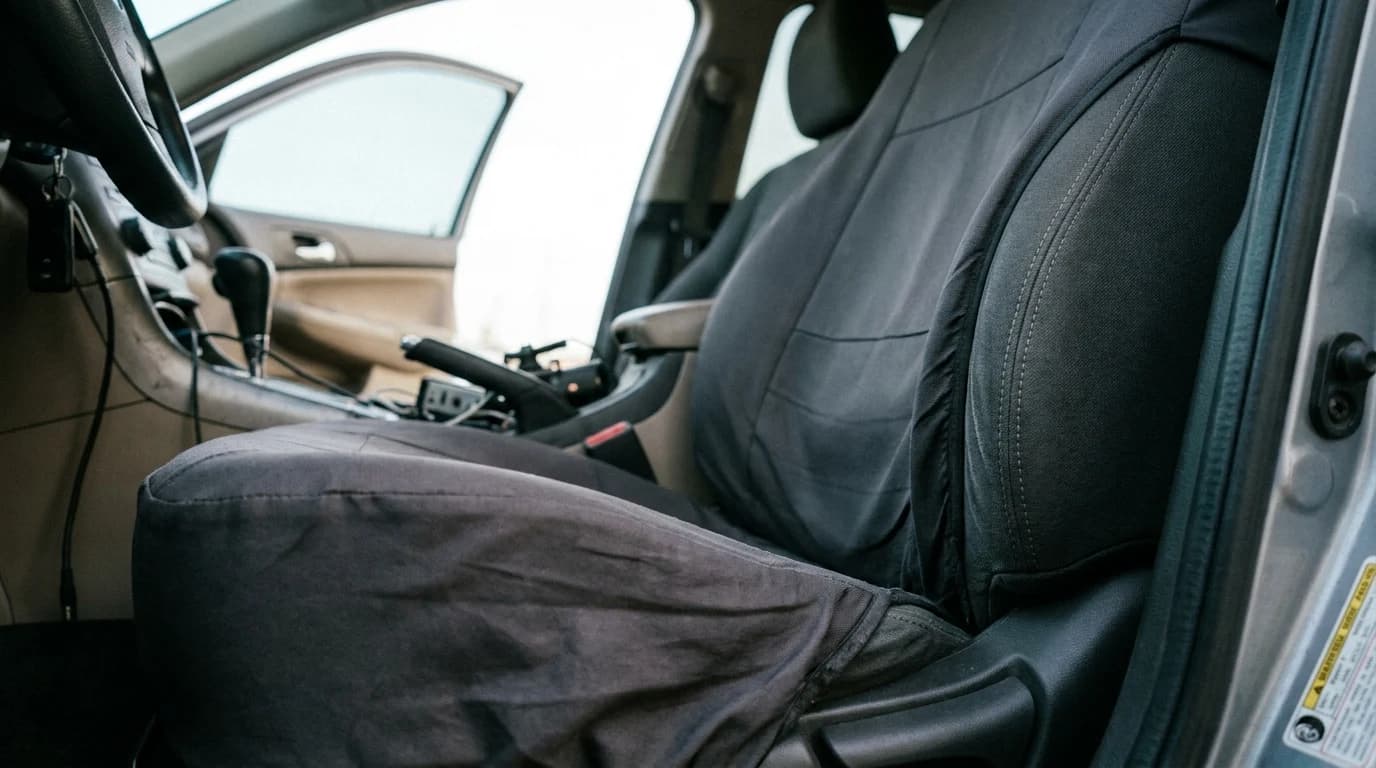
Plenty of seats have nothing to interfere with. A rear bench in most vehicles has no seat-mounted airbag, and a car whose side protection is roof-rail curtains only has no deployment path through the seatback. On those seats the seat cover question collapses back into fit, grip and material — a much easier decision, and one where a universal set is genuinely fine.
The trap is assuming your car is in that group because the seat has no tag on it, or because a listing said the cover was compatible. Neither of those is evidence. Your manual is.
Your next step
Only compare covers after confirming the exact seat and side-airbag construction.
Common questions
Are airbag-compatible seat covers actually tested?
Is it illegal to put seat covers on a seat with a side airbag?
How do I know whether my seat has a side airbag in it?
What does Toyota say about aftermarket seat covers?
Does a cover being custom-fit make it airbag-safe?
Research Sources
- NHTSA Chief Counsel interpretation 11-000699 (Aug 17, 2011) — no FMVSS applies to aftermarket seat covers, no certification program, no required side-airbag compatibility testing, no known industry standard, no required airbag label
- NHTSA Chief Counsel interpretation 08-002983 (Nov 20, 2008) — the make-inoperative prohibition of 49 U.S.C. 30122 binds businesses, not vehicle owners; FMVSS 208 seat sensing and FMVSS 214 seat-mounted side airbags
- Toyota Technical Service Bulletin T-SB-0122-11 Rev1 — Seat Cover Replacement for Side Airbag Equipped Vehicles (1998-2014), filed with NHTSA
- FH Group Auto FAQ — side-impact airbag compatibility, and the statement that not all of its seat covers are designed for that feature