Quick Answer
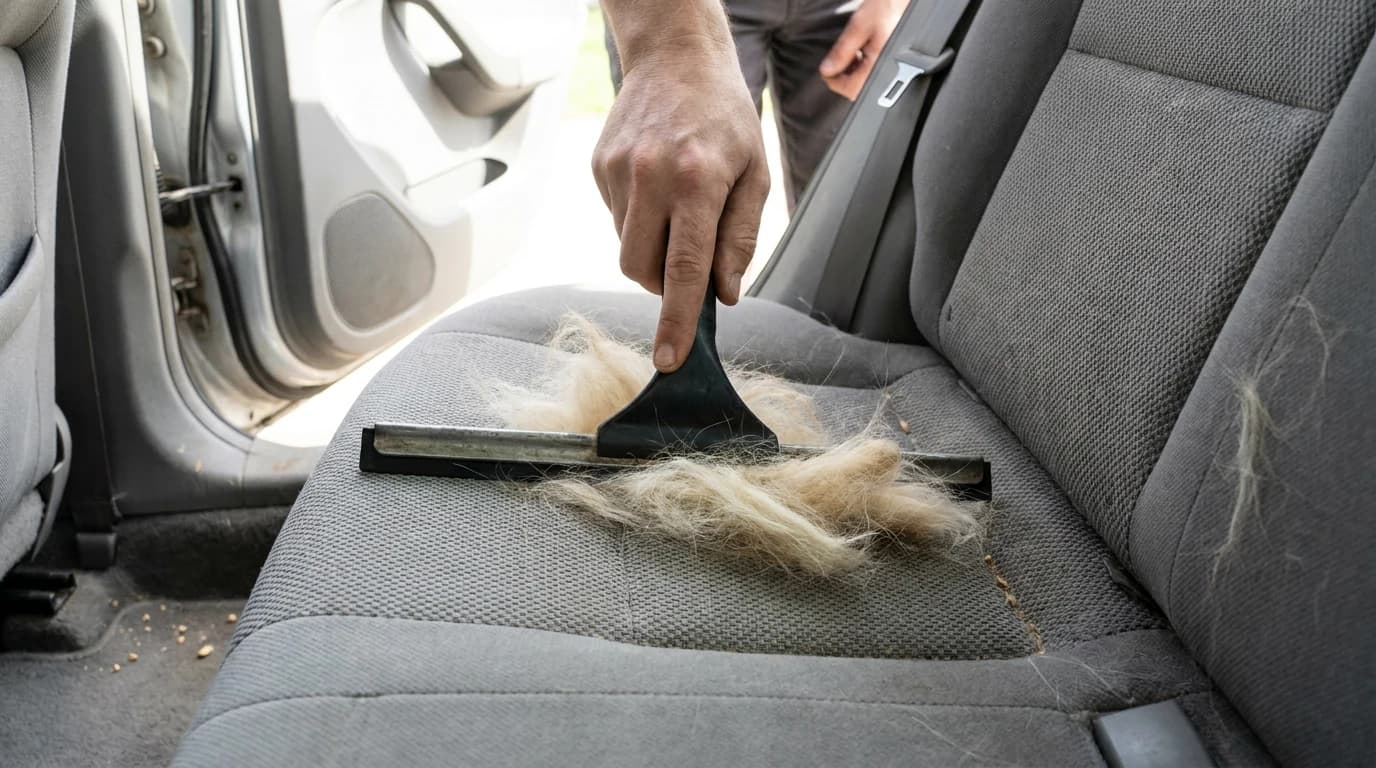
Agitate before you vacuum. Pull a dry rubber squeegee or rubber glove across the fabric in one consistent direction until the hair rolls into ropes, pick those up by hand, then repeat with a barely-damp rubber edge on the worst strip. Only then vacuum, ideally with a motorised brush head, and finish with a crevice tool in the seams and seat rails. Hair that is woven into carpet loops does not respond to airflow until something physically frees it.
Key takeaways
- Embedded pet hair is anchored between fabric loops, so a vacuum nozzle pulls on the exposed end while the rest stays put. Extra suction does not change that.
- The sequence that works is agitate, collect by hand, damp-agitate the worst strip, then vacuum, then crevice-tool the seams.
- Every major vacuum brand sells a motorised brush or upholstery brush for pet hair, which is an admission that airflow alone is not sufficient.
- A rubber squeegee, a rubber glove and a fabric pumice block cost a fraction of a vacuum upgrade and do the step the vacuum cannot.
Which tool for which surface
| If your situation is… | Pick | Why |
|---|---|---|
| Flat cloth seat cushions and the cargo floor | Dry rubber window squeegee | The long straight edge covers the most area per stroke and rolls hair into ropes you can lift by hand, which is faster than any nozzle. |
| Contoured bolsters, headrests and door cards | Dry rubber glove | Your hand follows curves a rigid blade skips over, and the same rubber drag effect applies. Slower per square inch, but it reaches what the squeegee misses. |
| Coarse woven seats and rubber-backed floor mats | Fabric pumice block | The abrasive face grabs hair that is worked deep into a coarse weave. Keep it away from leather, vinyl and the headliner, where it will mark the surface. |
| Deep-pile carpet after the rubber pass | Vacuum with a motorised brush head | A powered brush keeps agitating while the airflow lifts, which is the one job suction-only handhelds genuinely cannot do on carpet pile. |
| Seat seams, seat rails and the seatbelt slot | Crevice tool | Hair collects in the gaps no rubber edge can enter, and it migrates back onto clean fabric within a week if you leave it there. |
| A muddy or wet mess mixed in with the hair | Corded wet/dry vacuum | Cordless handhelds are dry-only and their cups fill fast. A tanked wet/dry unit takes liquid and reaches the rear footwell on its hose. |
Use this row to shortcut by situation.
Nearly every guide to this job opens by telling you to buy a better vacuum. That is the wrong first move, and it is why so many sessions end with a car that still sheds onto the next passenger.
Shed hair does not sit on upholstery the way crumbs do. Seat fabric and cut-pile carpet are loops and channels, and a tapered hair works down between the fibres and stays there under ordinary seat pressure. A nozzle pulls on the exposed end; the anchored length does not move. That is a geometry problem, not a suction-strength problem, and no amount of extra Pa solves it.
The fix is an order of operations, not a purchase.
The test: if your second vacuum pass lifts noticeably more hair than the first, you vacuumed too early. Everything that came up on pass two should have been freed by agitation before the nozzle ever arrived.
The vacuum makers already agree with this
Check the claim against the companies selling the machines. Shark's listing for the UltraCyclone Pet Pro+ describes a self-cleaning motorised Pet Power Brush whose stated job is removing stubborn pet hair on upholstery — a mechanical agitator bolted onto something that already has suction. Dyson's Car+Boat ships a mini motorised tool, the Bissell Pet Hair Eraser a motorised brush, and even the Black+Decker dustbuster lists an upholstery brush in the box.
If airflow alone were enough, none of those attachments would exist. The category is a standing admission that fibres have to be disturbed before suction can do anything useful.
The order that works
1. Dry-agitate before anything else. A rubber window squeegee, a dry rubber washing-up glove, or a fabric pumice block. Pull in one direction only, in short overlapping strokes toward yourself. Hair rolls into visible ropes ahead of the rubber edge. Consistent direction is what converts a fuzz layer into a collectible pile.
2. Collect by hand. Pick the ropes off and bin them. Vacuuming at this stage burns battery on hair you can lift with two fingers, and a handheld's cup fills embarrassingly fast.
3. Damp-agitate the stubborn strip. Dampen the tool, never the seat. A barely-moist rubber edge stops fine hair springing back on static and catches the short undercoat hairs the dry pass skated over. No glove? Wring a microfibre cloth almost dry and wrap it round two fingers.
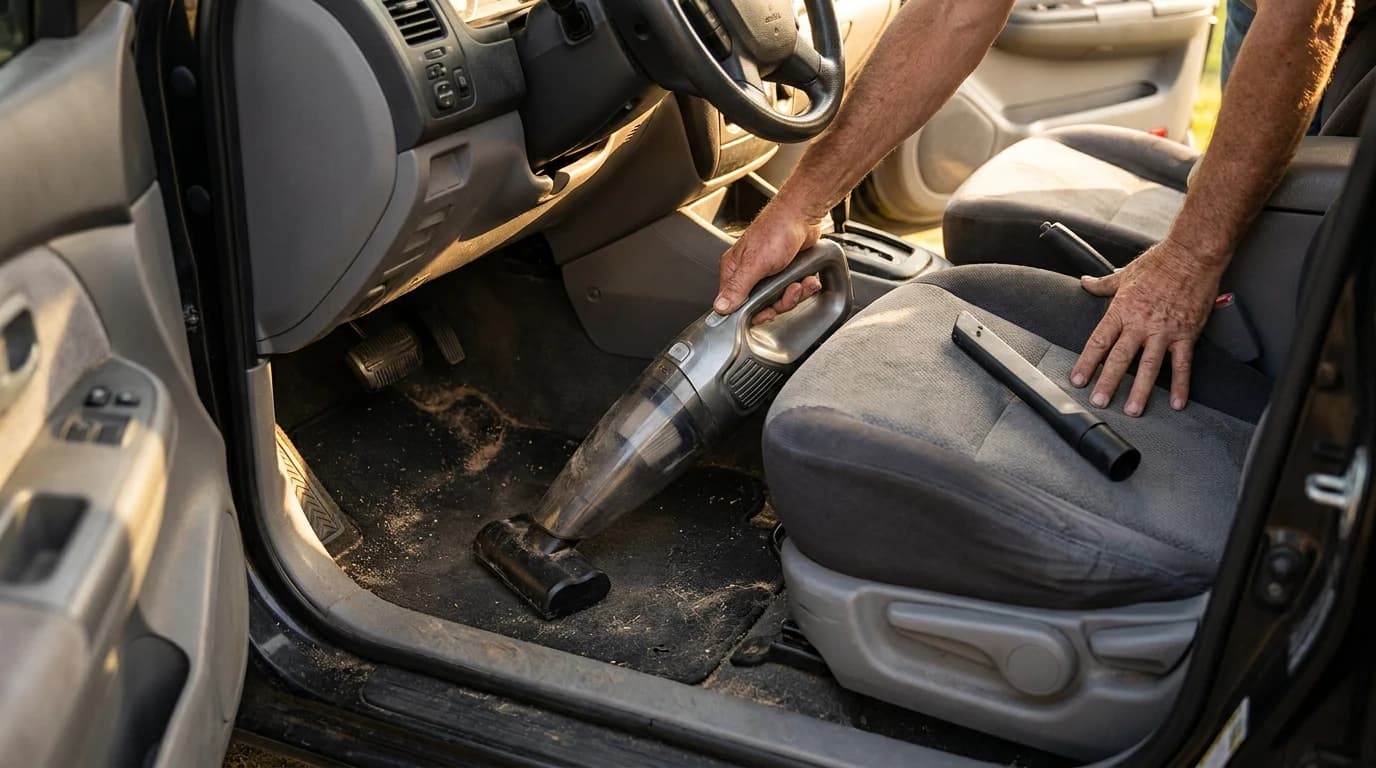
4. Vacuum last, not first. Now the machine has loose hair to carry away rather than anchored hair to fight. This is where the motorised brush head earns its money, and where a corded 12V handheld or a wet/dry shop vac beats a cordless on the one axis that matters: it never dies halfway through the rear bench.
5. Seams, rails and belt tracks. Crevice tool along the seat-back seam, under the rails, and down the seatbelt slot. This is where the hair you missed lives, and where it comes back from.
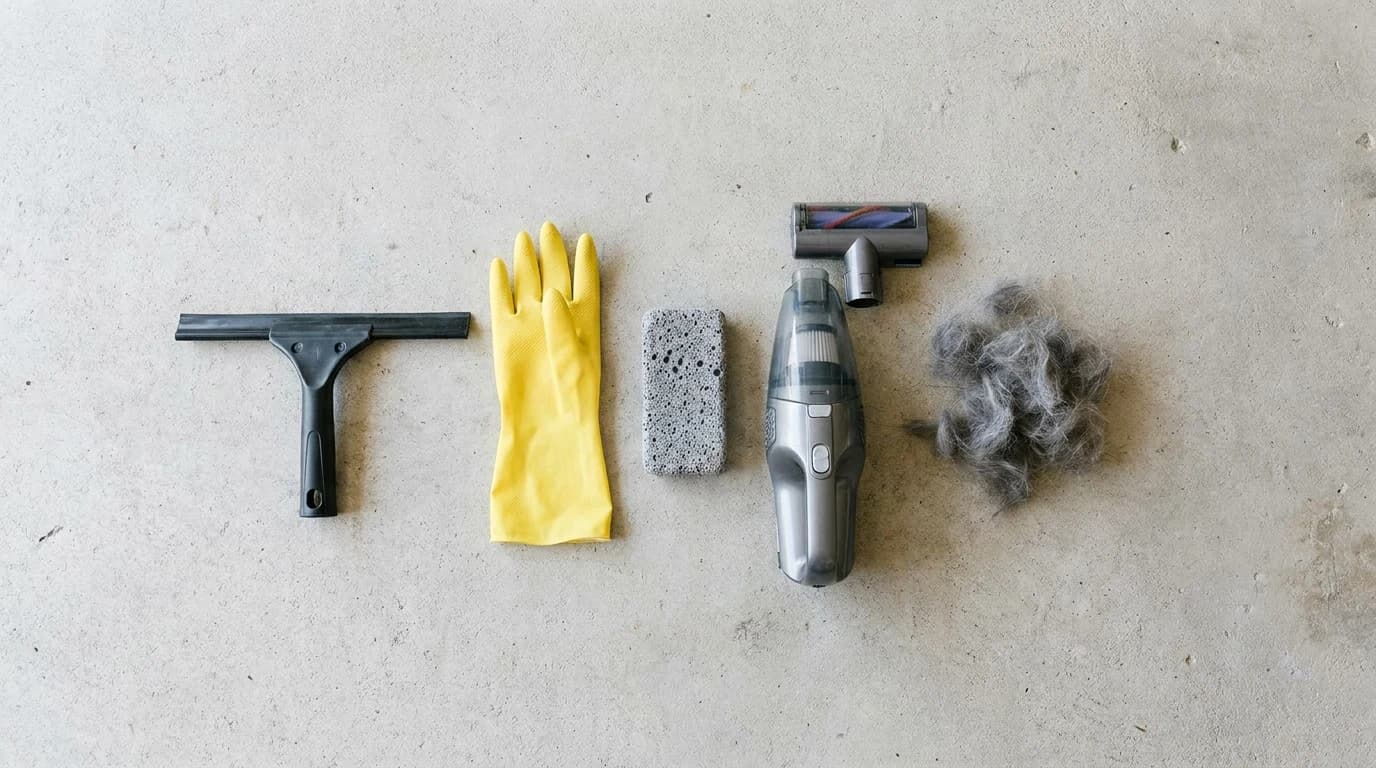
What each tool is actually for
| Tool | Best on | What it will not do |
|---|---|---|
| Rubber squeegee | Flat seat cushions, cargo floor, carpet | Reach seams or contoured bolsters |
| Rubber glove | Bolsters, headrests, door cards, curved trim | Cover large areas quickly |
| Fabric pumice block | Coarse woven seats and mats | Safe on leather, vinyl or headliner |
| Motorised brush head | Deep pile carpet and floor mats | Fit into seat rails or seams |
| Crevice tool | Seams, rails, belt tracks | Lift anything woven into pile |
Where the hair actually hides
The visible layer on the seat cushion is the easy half. The half that keeps re-appearing sits in four places most people never touch: the seat-back seam, the gap where the cushion meets the backrest, the carpet under the front seats, and the fabric side of the cargo cover. Do those four before you declare the job finished.
Do not do this: never take a pumice block to leather, vinyl or the headliner, and never soak fabric to make hair clump. A wet seat traps the next round of hair instead of releasing it, and takes a day to dry.
What works, and what people try instead
What actually shifts embedded hair:
- One-directional strokes with a dry rubber edge
- A barely-damp second pass on the worst strip
- Agitation first, suction second, seams last
- A washable filter emptied mid-job, before airflow drops
What gets recommended but underperforms:
- Buying a higher-Pa vacuum and changing nothing else
- Lint rollers, which lift the top layer and leave the anchored hair
- Tape, which pulls fuzz off the surface and pills the fabric
- Circular scrubbing, which redistributes hair instead of gathering it
Making it come back slower
The American Kennel Club notes that seasonal shedders lose the most coat in spring and autumn, while thick double-coated breeds shed year-round — so the volume you are fighting is not constant, and the brushing that stops it happens before the dog gets in the car, not after.
Three habits do most of the work: brush the dog outside before a trip, put a washable blanket or a dog seat cover or hammock on the bench, and do a two-minute squeegee pass after any beach or trail day rather than a two-hour session in month three. Finish with a wipe-down of the hard trim using an interior cleaner, because hair clings to greasy plastic far more readily than to clean plastic.
If your current vacuum has no brush head at all, that — not its suction rating — is the upgrade worth making. Every model we score, with current pricing, is on the car vacuums page, and our buying guide explains why the Pa figure on the box is the least useful number in the listing.
Your next step
After loosening the hair, choose a vacuum with the agitation and reach to remove it.
Common questions
Why does my vacuum leave dog hair behind even though it has strong suction?
Does a rubber glove really work better than a lint roller?
Should I dampen the seat to make the hair clump together?
Is a pumice or fabric stone safe on car upholstery?
How often should I do this if my dog rides with me every day?
Do I need to buy a vacuum with a motorised brush head?
Research Sources
- Shark — UltraCyclone Pet Pro+ Cordless Handheld Vacuum (CH951) product specifications
- Black+Decker — dustbuster AdvancedClean (HHVI320JR02) specifications and included tools
- Vacmaster (Cleva) — Armor All 2.5 Gallon 2 Peak HP Utility Wet/Dry Vacuum specifications
- American Kennel Club — Dog Shedding: What to Expect and How to Manage It
- American Kennel Club — What Is a Double Coat, and What Dog Breeds Are Double-Coated?