How Much Does It Cost to Charge an Electric Car (or a Tesla) at Home?
Multiply the kilowatt-hours you put in by your electricity rate, then allow roughly 10 to 15 percent for charging losses. A near-full charge of a 60 kWh-class EV at about 16 cents per kWh lands near 10 dollars. For a Tesla, EPA rates the 2025 Model Y Long Range AWD at 29 kWh per 100 miles, about 4.6 dollars per 100 miles at that rate. Off-peak time-of-use rates cut it further.
Key takeaways
- Home charging cost equals kWh added to the battery times your electricity rate, divided by charging efficiency of about 85 to 90 percent.
- A near-full charge of a typical 60 kWh EV commonly lands around 9 to 10 dollars at an average residential rate, far below the cost of an equivalent tank of gas.
- Level 2 does not lower your cost versus Level 1. It only charges faster, so the same energy moves in less time.
- Time-of-use off-peak rates are the single biggest savings lever, and home charging is dramatically cheaper than public DC fast charging.
Which home charging approach fits you
| If your situation is… | Pick | Why |
|---|---|---|
| You charge overnight and your utility offers time-of-use rates | Level 2 on a scheduled off-peak window | Off-peak pricing is the largest lever on cost, and a Level 2 unit can refill the battery inside a cheap overnight window. |
| You drive a short daily commute and rarely run the battery low | Level 1 on a standard 120V outlet | The energy and cost per kWh are identical to Level 2. If a few miles of range per hour keeps up with your driving, the slower speed costs you nothing. |
| You have a long commute or a larger battery to refill nightly | Level 2 hardwired or on a 240V circuit | The cost per charge does not change, but Level 2 adds most of a day of driving overnight so you start each morning full. |
| You are away from home and tempted to top up at a fast charger | Charge at home whenever you can, use DC fast charging only for trips | Public DC fast charging typically costs several times your home rate. It buys speed on road trips, not everyday savings. |
| You want to know your exact number before buying hardware | Run your battery size and utility rate through the calculator | Cost is driven by your specific rate and battery, so plugging in real figures beats any national average. |
Use this row to shortcut by situation.
The sticker shock people expect from charging an electric car at home almost never arrives. Where a tank of gas is a memorable double-digit hit at the pump, topping up an EV overnight tends to cost a few dollars and disappears into your monthly power bill. The reason it feels mysterious is that the number is never printed on a screen the way a fuel price is. So let us do the actual math, because it is genuinely simple.
The formula
Home charging cost comes down to one equation:
Cost = (kWh added to the battery ÷ charging efficiency) × your electricity rate
Every piece of that is a number you can look up:
- kWh added — how much energy the battery took on.
- Your electricity rate — in dollars per kWh, printed on your utility bill.
- Charging efficiency — the only piece that trips people up. Not every kilowatt-hour that leaves the wall reaches the battery; some is lost as heat in the charger, the cable, and the car's onboard electronics, and cold weather widens that gap. A reasonable working range is 85 to 90 percent, so you pull roughly 10 to 15 percent more from the wall than the battery actually stores.
A worked example
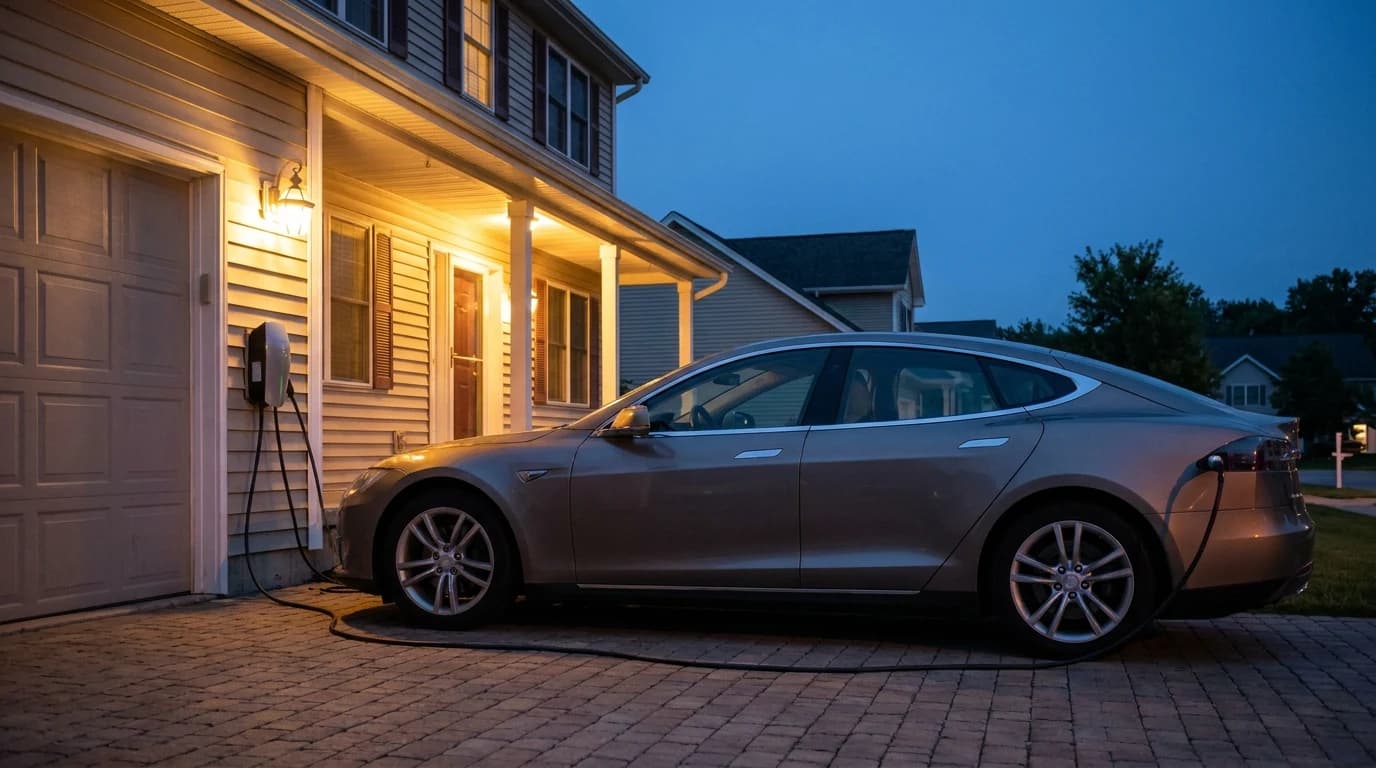
Take a mainstream EV with about a 60 kWh usable battery. Say you are refilling from nearly empty to nearly full and adding around 55 kWh to the battery. At 88 percent efficiency, the wall actually delivers about 55 ÷ 0.88, or roughly 62 kWh. Residential electricity in the US commonly runs in the ballpark of 16 cents per kWh, though your own bill is the number that counts. That puts the charge at about 62 × 0.16, or close to 10 dollars for a near-full charge.
Worth knowing: spread across the roughly 190 to 210 miles that 55 kWh moves in an efficient EV, the energy works out to only a few cents per mile — comfortably below what the same distance costs in a gasoline car at pump prices.
The US Department of Energy and EPA cover this comparison in plain terms in their electric vehicle guidance.
How much does it cost to charge a Tesla?
About 4.6 dollars per 100 miles for a Model Y at 16 cents per kWh, using the car's EPA figure rather than a guessed battery size. fueleconomy.gov rates the 2025 Tesla Model Y Long Range AWD at 29 kWh per 100 miles, with a 311-mile range:
| Step | Arithmetic | Result |
|---|---|---|
| Energy per 100 miles | EPA label figure | 29 kWh |
| Cost per 100 miles at 16 cents | 29 × 0.16 | about 4.64 dollars |
| Energy for the full 311-mile range | 311 ÷ 100 × 29 | about 90 kWh |
| Cost of that range at 16 cents | 90 × 0.16 | about 14.40 dollars |
Swap in your own rate; it is the only number in the table that changes from house to house. EPA's label describes 29 kWh as the energy the car uses to travel 100 miles and does not say whether wall-side charging losses are inside it, so treat the result as an estimate and let your bill settle it.
Worth knowing: the arithmetic is the same for any EV. Find its kWh-per-100-miles figure on fueleconomy.gov and multiply by your rate.
What actually drives the number
Three inputs move your cost, and only three:
| Factor | Effect on cost | Notes |
|---|---|---|
| Your electricity rate | Direct multiplier | The single biggest variable; ranges widely by utility and time of day |
| Charging efficiency | 10 to 15 percent overhead | Worse in cold weather; unavoidable but modest |
| Battery size / amount added | Scales the total | You pay for energy added, not battery capacity |
Notice what is not on that list: the level of your charger. This surprises people, so it is worth stating plainly.
Level 1 vs Level 2: speed, not price
A Level 1 setup uses a standard 120V household outlet and adds only a few miles of range per hour. A Level 2 setup on a 240V circuit adds most of a day's driving overnight.
The trap: the two levels move the same kilowatt-hours at the same price per kWh, so a full charge costs the same on either one. Level 2 buys you speed and convenience, not cheaper electricity.
If a short commute means Level 1 keeps up with your driving, the slower speed costs you nothing. If you need to refill a larger battery every night, Level 2 is worth it for the time, not the money. Our EV home charger buying guide walks through when the faster hardware earns its place, and the EV home chargers category covers the units themselves.
How long does it take to charge an electric car at home?
Divide the kilowatt-hours you need by the charger's power. The Department of Energy's Alternative Fuels Data Center puts Level 1 at about 1.9 kW, or roughly 5 miles of range per hour, and says most home Level 2 chargers run at up to 30 amps and deliver 7.2 kW, roughly 25 miles of range per hour.
| Charger | Power (AFDC) | Range added per hour (AFDC) | Time for the Model Y's 90 kWh, our arithmetic |
|---|---|---|---|
| Level 1, 120 V outlet | about 1.9 kW | about 5 miles | about 47 hours |
| Typical home Level 2, 30 A on 240 V | 7.2 kW | about 25 miles | about 12.5 hours |
| Level 2, full range of units | 2.9 to 19.2 kW | depends on the unit | depends on the car's onboard charger |
| DC fast charging, away from home | up to 500 kW | 100 to 200+ miles per 30 minutes | depends on the car |
That 12.5-hour estimate lines up with the EPA label, which lists the 2025 Model Y Long Range AWD at 12 hours to charge from empty on 240 volts. Few people charge from empty, so a normal overnight top-up is far shorter. Our EV charging calculator runs these numbers for your own car and rate.
The biggest lever: off-peak charging
If your utility offers a time-of-use rate, this is where the real savings live. Off-peak electricity — typically overnight — can be priced well below the daytime rate, and an EV is the ideal appliance to shift into that cheap window because it charges while you sleep. Most cars and chargers let you schedule a start time so this happens automatically.
What actually moves your bill:
- Your electricity rate, and whether you charge on- or off-peak
- How many kWh you add, which follows your driving
- Cold weather, which widens the efficiency gap
What barely moves it:
- Level 1 versus Level 2 — same energy, same price per kWh
- The charger's amperage rating, which buys speed rather than cheaper power
The Department of Energy's guide to charging at home is a good primer on setting this up. Shifting your charging to off-peak hours usually saves more than any hardware decision you could make.
Why home beats public fast charging
The flip side of cheap home charging is that public DC fast charging carries a convenience premium and typically costs several times your residential rate. That is the price of speed on a road trip, and it is worth it when you need range in minutes. But it is a poor everyday habit. The math above is exactly why so much EV ownership advice, including the EPA's rundown of common electric vehicle myths, points owners toward home charging as the default and fast charging as the exception.
Run your own numbers
National averages are a starting point, not an answer, because your cost is dominated by your specific rate and battery. Plug your figures into our EV charging calculator to get a number that reflects your utility, your car, and whether you charge on- or off-peak. Once you see it, the mystery evaporates — and so does the sticker shock.
Your next step
Use the cost estimate to size the charger and electrical installation you actually need.
Common questions
How much does it cost to charge a Tesla at home?
How long does it take to charge an electric car at home?
What is the formula for home EV charging cost?
Does a Level 2 charger cost more per charge than Level 1?
How can I lower my EV charging cost the most?
Is charging at home cheaper than public fast charging?
Why does charging efficiency matter for the cost?
How does the per-mile cost compare to gasoline?
Research Sources
- US DOE Alternative Fuels Data Center — Charging at Home
- FuelEconomy.gov — Electric Vehicles (US DOE and EPA)
- US EPA — Electric Vehicle Myths
- fueleconomy.gov — 2025 Tesla Model Y Long Range AWD: 29 kWh/100 mi, 311-mile EPA range, 12 hours to charge at 240V
- fueleconomy.gov — Learn more about the electric vehicle label: what the kWh/100 mi figure and the 240-volt time-to-charge figure mean
- US DOE Alternative Fuels Data Center — Developing Infrastructure to Charge EVs: Level 1 about 1.9 kW and 5 miles per hour, residential Level 2 at 7.2 kW and about 25 miles per hour, DC fast up to 500 kW