Quick Answer
Clean before you buy. Wash the windshield, lift each blade and wipe the element, run the washers, then re-check the sweep. General Motors' service bulletin gives its technicians that exact order and tells them to replace the blades only if the fault can be recreated afterwards. If chatter survives a new blade, the cause is almost certainly the arm, not the rubber: at the park position the blade body should sit angled slightly toward the rear of the car, and at the far end of its travel slightly toward the centre. If it is angled the other way, the arm is bent and a second new blade will chatter too.
Key takeaways
- GM's service bulletin tells technicians to clean the glass and the blade element, re-test, and replace the blades only if the fault comes back. Streaking is the most common wiper warranty condition on GM models, and worn rubber is not the only cause.
- Chatter has four causes in GM's list and only one of them is the blade. High arm tip force, ice packed into the hinge, and a bent arm holding the blade at the wrong angle all survive a replacement.
- The honest replacement interval is not “every six months”, it is whatever your carmaker warrants. GM covers wiper wear for 12 months or 7,500 miles; Volkswagen covered it for 6 months or 6,000 miles on 2013–2017 cars.
- GM and VW give opposite instructions on cleaning the rubber element itself. They agree completely on the glass, so clean that first and check your own manual before you scrub a blade.
Start here, by symptom
| If your situation is… | Pick | Why |
|---|---|---|
| Streaks crept in over months, on blades you have never cleaned | Clean the glass and the element, then re-test | GM's bulletin instructs technicians to replace blades only if the wipe fault can be recreated after both the glass and the blades have been cleaned. |
| Chatter started the day you fitted brand-new blades | Check the arm angle before spending anything else | GM lists high wiper-arm tip force and a bent arm holding the blade at an improper angle as chatter causes that a blade change cannot touch. |
| Smearing began right after a wax or drying-aid car wash | Deep-clean the glass, leave the blades alone | VW names drying-aid remnants and washer-fluid nano coatings as streak and chatter causes, and prescribes a clay-bar decontamination of the glass rather than new blades. |
| One blade leaves an unwiped band along part of its sweep | Check the blade for a warp and the arm for a bend | Both bulletins list a warped blade and a bent or misadjusted arm as separate faults, and only the first one is solved by buying a blade. |
| Blades are past the maker's wear window and visibly nicked or torn | Replace both, matched to your car's two sizes and connector | A torn or nicked element is the case a new blade genuinely fixes; GM's own wear window is 12 months or 7,500 miles and VW's was 6 months or 6,000 miles. |
Use this row to shortcut by situation.
The reflex when the windshield smears is to buy blades. It is the wrong first move often enough that General Motors wrote a service bulletin telling its own technicians not to make it.
Bulletin 24-NA-164, issued March 2025 for all GM passenger cars and trucks, names streaking as the most common wiper warranty condition on GM models — then says worn blades are not the only cause. The procedure it gives technicians ends with an instruction that costs the parts counter a sale: if cleaning the glass and the blade fixes the wipe, do not replace the blade.
Rule of thumb: a wiper complaint has four possible homes — the blade, the glass, the arm, and the chemistry somebody put on the glass. Only one of them is solved by shopping.
Match the symptom before you match the size
Two service bulletins do most of the work here: GM's, and Volkswagen's 92 17 01, Windshield Wipers Do Not Clean Properly or are Noisy During Operation. Between them they sort the symptoms.
| What you see | What the bulletins name as the cause | Does a new blade fix it? |
|---|---|---|
| Streaking | Tears or nicks in the element, contamination on the blade or glass, non-uniform element edges as manufactured | Sometimes |
| Smearing, or simply not cleaning | Cleaning-product residue, industrial fallout, high-gloss drying-aid remnants, nano coating from some washer fluids | No |
| Chatter or juddering | Permanent set in the blade, high tip force of the arm, snow or ice in the blade hinge, blade not sitting at the proper angle | One cause in four |
| A band left unwiped along part of the sweep | A warped or bent blade, or a bent or misadjusted arm | Not if it is the arm |
The five minutes GM asks for before the parts counter
GM's diagnostic order is short, free, and specific:
- Clean the windshield with a cleaner that will not scratch the glass or harm the paint.
- Lift each blade off the glass and clean the element with a lint-free cloth saturated with washer solvent.
- Put both blades back down and run the washers.
- Re-check the wipe. GM's rule: replace the blades only if the problem can be recreated after cleaning both the glass and the blades.
Where two carmakers flatly disagree
Step 2 above is not universal advice, and this is the part no buying guide mentions. GM tells technicians to clean the rubber element with washer solvent. Volkswagen's bulletin says the opposite, in a boxed note: do not attempt to wipe or clean the wiper rubber edges with a cloth or chemicals, because the blades are manufactured with a treated surface that requires no maintenance. Both documents are official guidance, each for its own vehicles.
The two bulletins agree completely on the glass — clean it first, every time. They disagree only about scrubbing the rubber. Follow your own manufacturer's manual on that step.
The trap: where your manual is silent, take the cautious version of a disputed instruction. Clean the glass, leave the element alone, re-test.
How long a blade should actually last
"Replace them every six months" is everywhere and attributed to nobody. The closest thing to a manufacturer's number is what each carmaker is willing to pay for:
| Manufacturer | Wiper wear-and-tear coverage |
|---|---|
| General Motors, 2023–2025 model years | 12 months or 7,500 miles |
| Volkswagen, 2013–2017 model years | 6 months or 6,000 miles |
GM's bulletin also states that from the 2026 model year, wiper blades and inserts stop being a warrantable item on its vehicles entirely — and that the interval moves with where you drive: dusty roads wear the rubber edge quickly and unevenly, sand and salt accelerate it, heavy-snowfall areas need blades more often.
What a new blade cannot fix
A new blade fixes: a torn or nicked element; rubber worn past its useful life; non-uniform element edges; a blade that has warped or been bent.
A new blade does not fix: a bent or misadjusted arm; excessive arm tip force; contamination embedded in the glass; a drying-aid or nano-coating film; ice packed into the hinge.
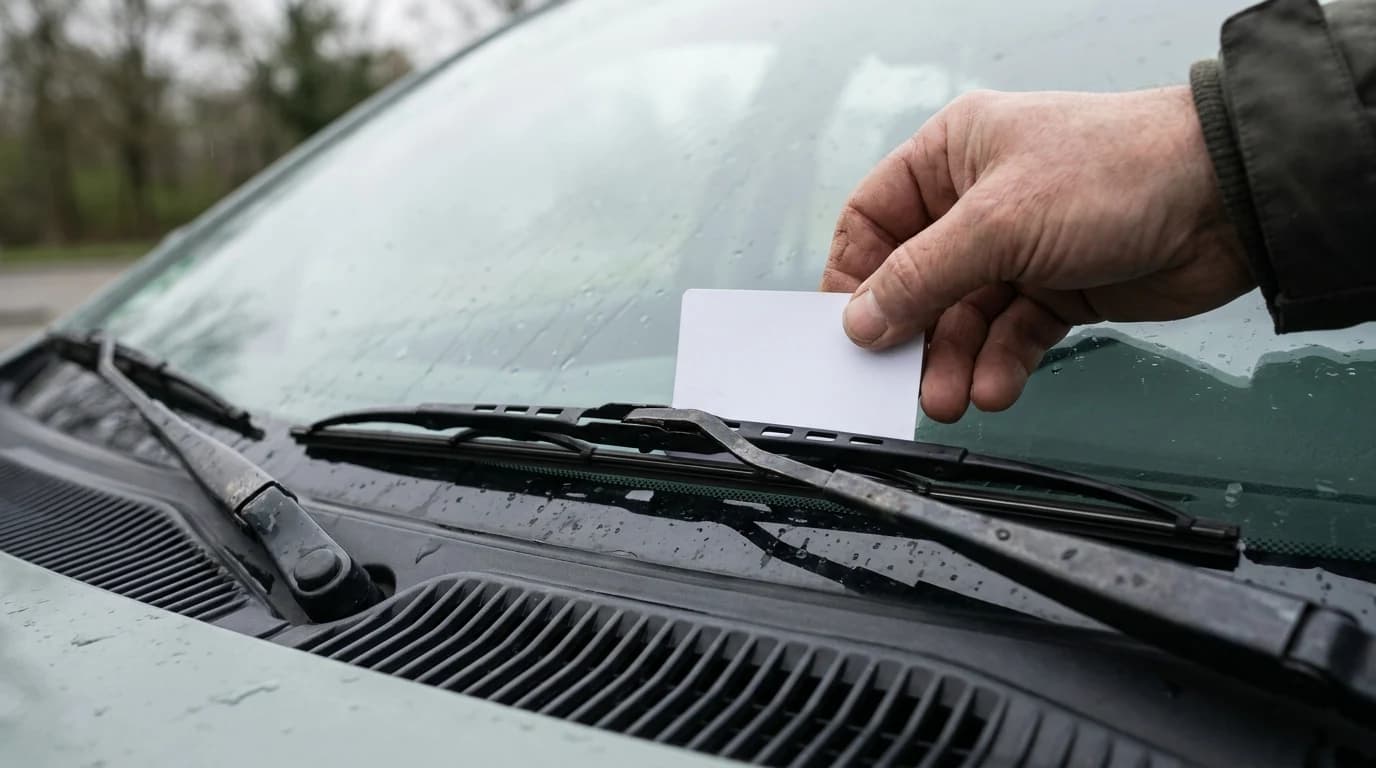
GM's arm check costs nothing and takes a minute. At the park position, the body of the blade should angle slightly toward the rear of the car. At the far end of its travel, it should angle slightly toward the centre of the car. GM tells technicians to hold a business card or small square against the blade when the angle is hard to judge by eye. Angled forward at park, or outboard at the top of the sweep, means the arm is bent.
Worth knowing: a bent arm holds every blade at the wrong angle, so the replacement will chatter exactly like the one it replaced.
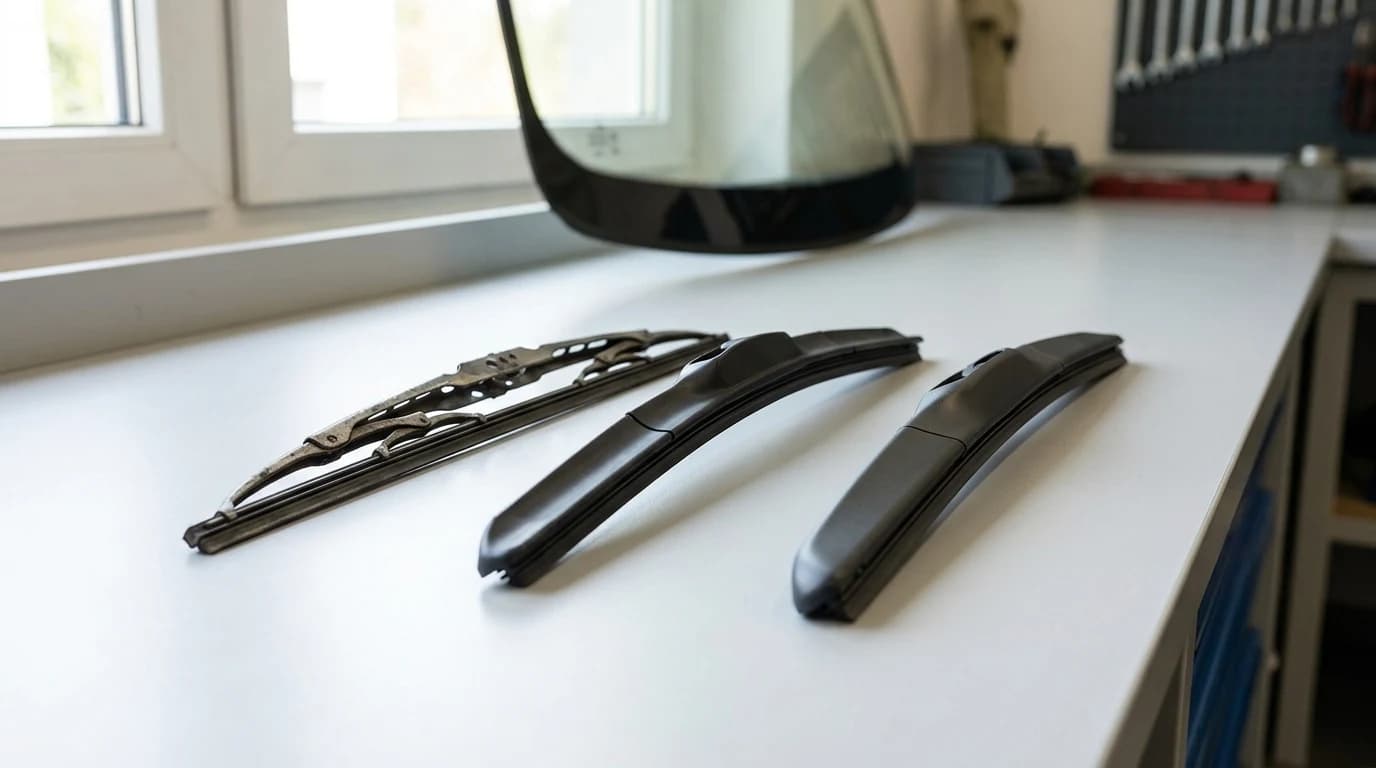
Ice in the hinge is the other cause mistaken for a worn blade, and it is partly a design question — a covered-hinge hybrid blade is built to give snow less structure to pack into than an exposed conventional frame. GM's winter advice is blunter: never use the wipers to wear through frost or clear snow, and never pull frozen blades off the glass.
The film nobody warns you about at the car wash
Both bulletins point at wash chemistry. VW lists high-gloss drying-aid remnants and nano coatings found in some washer fluids, warning that once applied a nano coating cannot be fully removed — the residue can leave marks that impair the driver's view. GM says drive-through washes with wax treatments and water repellents may compromise wipe quality and should be avoided.
If the smearing started after a wash, look there first. VW's fix is mechanical, not chemical: clay-bar the glass, feel it with your palm, repeat until smooth. Anyone already washing with a foam cannon or two buckets controls what lands on the glass to begin with.
Buy the pattern, not the blade
Your car was certified against a wipe pattern, not a blade length. FMVSS 104 sets minimum wiped percentages for three zones of the windshield — 80% of Area A, 94% of Area B and 99% of Area C — and requires at least one wiper speed of 45 cycles per minute. A shorter blade does not break the standard; it quietly gives back area the standard exists to protect.
Two things go wrong at checkout:
- Sizes are usually asymmetric. TRICO's installation guide says driver and passenger sides often take different lengths, that short blades compromise visibility, and that a blade that is too long can scratch the windshield.
- The connector is the fitment, not the blade. The classic J-hook slides off; others need a tab pushed, a pair of pinch tabs squeezed, or a locking tab released first. Beam blades ship with adapter sets — the adapter still has to be the right one.
Our own catalogue makes the trap obvious: four of the five blades we currently track in wiper blades are sold singly, not as a pair. The AERO Premium All-Season set is the exception, a matched 22-inch and 18-inch pair; the Bosch ICON 26A is one blade. A "pair" listing only saves you money when both of its sizes happen to be yours.
Your next step
Clean the glass and inspect the arm before replacing the blade.
Common questions
How often should windshield wiper blades be replaced?
My wipers still chatter after fitting new blades. What now?
Should I clean the rubber on my wiper blades?
Why did my wipers start smearing right after a car wash?
Do I have to use the exact wiper sizes my car came with?
Research Sources
- General Motors Service Bulletin 24-NA-164 (March 2025) — Information on Wiper Blade Maintenance Tips
- Volkswagen Technical Bulletin 92 17 01 (March 13, 2017) — Windshield Wipers Do Not Clean Properly or are Noisy During Operation
- 49 CFR 571.104 — FMVSS No. 104, Windshield wiping and washing systems (wiped-area and frequency requirements)
- TRICO — How to Replace Your Windshield Wipers (blade sizing and wiper-arm connector types)