What Size Wiper Blades Do I Need? Sizes, Types & How to Change Them
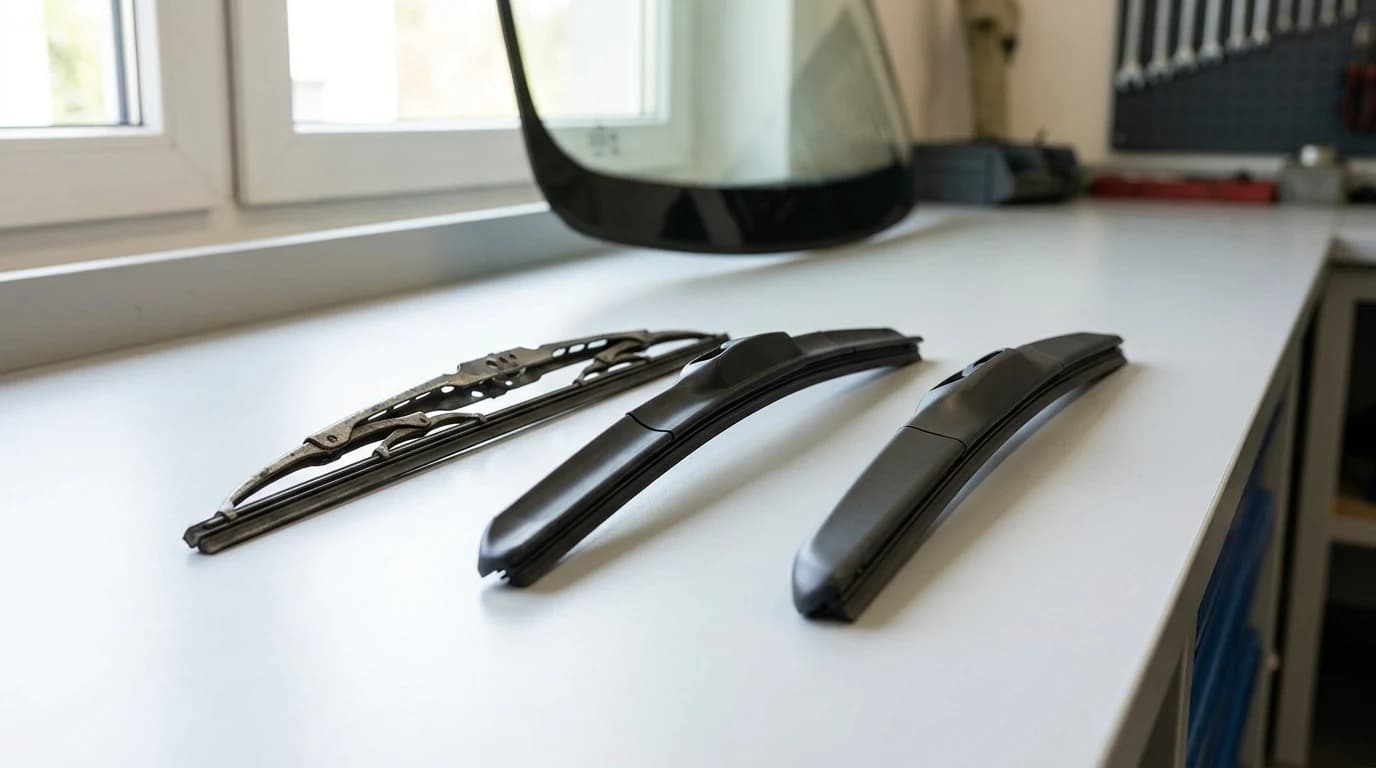
The three types of wiper blades are conventional (a metal bracket frame with pivoting claws), beam (one curved, tensioned steel strip inside a one-piece rubber body) and hybrid (a framed blade under an aerodynamic shell). Your size is two numbers, not one: TRICO says driver and passenger arms differ, so check the owner's manual or measure each rubber element. Beam blades suit curved modern windshields and winter, but the arm's connector decides what fits.
Key takeaways
- Three constructions cover the whole market, and manufacturers name them the same way: Bosch's catalogue filter sorts its range into Beam, Conventional, Hybrid, Twin, Heavy Duty and Specialty, and Rain-X splits its Expert Fit OE-replacement line into Beam, Hybrid, Conventional and Rear.
- The beam's advantage is pressure distribution, not marketing. TRICO says its Memory Curve Steel provides uniform pressure across the entire wiper blade, which a bracket frame cannot do — it presses at each claw and relaxes between them.
- Different lengths per side is the design. TRICO states that wiper arms are unique to the driver and passenger sides with discrete geometry between the two locations; Rain-X lists a 2024 Jeep Grand Cherokee at 26 inches driver and 20 inches passenger.
- Measure the rubber element, not the metal frame. TRICO's size guide is explicit, and a too-long blade can hang over the windshield edge or collide with the other blade mid-sweep.
- Rain-X's Blade Size Finder widget is currently showing a technical-difficulties notice, but its static per-vehicle pages still return sizes — a working fallback while the tool itself is down.
- Rear wipers are a separate fitment family on most hatchbacks and SUVs. Look them up by vehicle; a front blade of the same length will not fit.

Bosch ICON 26A — premium beam wiper blade (26", single)
- Dual-rubber FX element resists heat and ozone for longer edge life
- Beam design has no exposed frame to pack with snow or ice
- 22,000+ ratings at 4.5 stars — a long track record
Our top-ranked beam blade: a tensioned beam frame with no exposed frame to pack with snow or ice, and a dual-rubber element. It is sold as a single blade, so measure the driver and passenger sides and check your arm connector first.
Which construction the situation actually calls for
| If your situation is… | Pick | Why |
|---|---|---|
| A curved windshield on a car built in the last decade, in a climate with real winters | A beam blade, one per side at your two sizes | Beam blades have no open brackets to pack with snow and ice, and TRICO attributes their even glass contact to a single curved tensioned steel strip rather than pivoting claws. |
| The car came from the factory with a shelled blade that is clearly not a plain beam | A hybrid, matched to the original fitment | Hybrids are a framed blade under an aerodynamic shell, and both Bosch and Rain-X list them chiefly as OE-replacement lines rather than upgrades. |
| An older vehicle whose arm will not latch anything but a bracket blade | A conventional blade in the size the manual lists | Fitment beats construction. Beam blades ship with adapters for common hooks, but an unusual factory fitting leaves the bracket blade as the only thing that clips on. |
| You want both front blades replaced for the least money and your sizes happen to be a stocked pair | A matched two-size beam pair | Pair listings are the cheapest route per blade, but they are only useful when the two sizes in the box are the two your car takes. |
| The rear glass on a hatchback, wagon or SUV | The vehicle-specific rear blade, looked up by model | Rear wipers use proprietary fitment families with their own part numbers, so a front blade of the same length will not attach. |
Use this row to shortcut by situation.
Two numbers and one word decide a wiper purchase: the driver blade length, the passenger blade length, and the construction the arm will accept. Lookup tools answer the first two. The third decides whether the blade survives a winter, and almost nobody covers it.
The three shapes, and what each one buys you
Every blade on a shelf is one of three constructions, and the industry names them consistently. Bosch's catalogue filter sorts its range into Beam, Conventional, Hybrid, Twin, Heavy Duty and Specialty. Rain-X splits its OE-replacement Expert Fit line the same four ways: Beam, Hybrid, Conventional and Rear.
| Type | How it is built | Where it wins | The trade-off |
|---|---|---|---|
| Conventional | A bracket frame with pivoting claws pressing a rubber element onto the glass | Flatter windshields, older arms, cheapest replacement | Open brackets pack with snow and ice; pivots lift at speed |
| Beam | One curved tensioned steel strip inside a one-piece rubber body, no brackets | Curved modern windshields, winter, highway speeds | Costs the most; a cheap one loses its curve early |
| Hybrid | A framed blade wearing a closed aerodynamic shell | Cars that came with a hybrid from the factory | Heavier than a beam; the shell hides the frame it still has |
The mechanism behind the beam's reputation is pressure distribution. TRICO builds its beam blades around Memory Curve Steel, which the company says "provides uniform pressure across the entire wiper blade", and Bosch describes its own beam designs as using dual precision-tensioned steel springs toward the same goal.
What that construction fixes:
- Even contact along the whole blade, where a bracket frame presses hard at each claw and relaxes between them.
- No open skeleton for snow and slush to pack into and freeze solid.
- A low profile that stays planted instead of lifting at highway speed.
What it does not fix:
- A bent or weak wiper arm, which holds any blade at the wrong angle.
- Contaminated glass, which smears under new rubber exactly as it did under old.
- A fitment mismatch, since an adapter that does not suit your arm makes the best blade unusable.
Construction is not purely your choice. A blade has to latch onto the hook, pin or bayonet the arm already carries. Beam blades ship with adapters for the common fittings, but an unusual factory arm can leave a conventional blade as the only thing that clips on.
Rule of thumb: the arm chooses first, you choose second. Confirm what your arm accepts, then pick the construction from what is left.
Read longevity claims narrowly. Bosch states the ICON "Lasts Up To 40% Longer Than Other Premium Blades" — a manufacturer claim about its own product, not an independent finding, and "up to" is carrying real weight in it.
Two blades, two lengths, and that is normal
The most common surprise at the parts counter is that the two front blades are different lengths. That is designed in. TRICO puts the reason plainly: "Your wiper arms are unique to the driver and passenger sides and in most cases will exhibit discrete geometry (side bends, down form, and overall length) between the two locations."
The gap is often large. Rain-X lists a 2024 Jeep Grand Cherokee as a 26-inch driver blade, a 20-inch passenger blade, and a separate rear blade in a different fitment family. Six inches apart on one windshield.
Getting it wrong cuts both ways. TRICO warns that blades that are too short "won't cover the entire windshield, leaving areas uncleaned", while blades that are too long "can hang over the edge of the windshield or interfere with each other's path" — a collision mid-sweep that no blade quality fixes.
Where your size actually lives
Four places carry the answer, in descending order of trust:
- The owner's manual. TRICO's size guide sends you here first. It is the only source published by the company that designed the arm geometry.
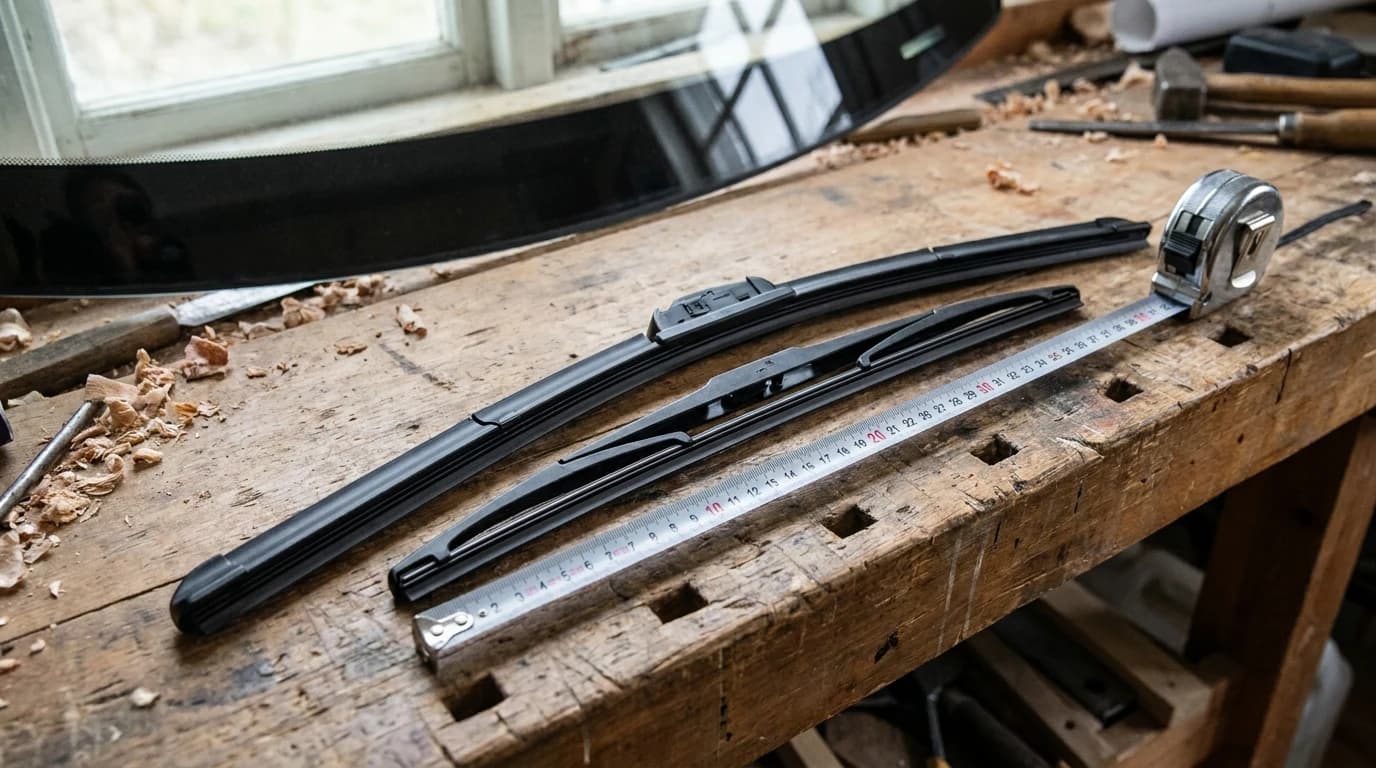
- The old blades. Measure the rubber element, not the metal frame — TRICO is explicit that the frame is longer than the wiping element and the wrong thing to measure.
- The manufacturer's or dealership's lookup. Second-hand, but tied to your trim and model year.
- A blade brand's size finder. Fastest, and the most likely to be wrong or unavailable.
That last caveat is not hypothetical. Rain-X's Blade Size Finder currently loads behind the notice "Apologies for any inconvenience caused. Our blade finder tool is currently experiencing technical difficulties." The widget is down — but the static per-vehicle pages behind it still serve sizes, so a URL of the form rainx.com/blade-finder/YEAR/MAKE/MODEL/ returns the driver, passenger and rear figures while the search box will not.
Check the tool against the manual. A brand's finder is the fastest route and the least reliable one — the one that dominates this search is partly broken as this is written, and its per-vehicle pages are the way around it.
Rear blades are their own problem. On most hatchbacks, wagons and SUVs the rear wiper is a proprietary fitment with its own part-number family, so buy it by vehicle lookup rather than by measuring.
How to change wiper blades (hook, pinch-tab and push-button arms)
TRICO's replacement guide splits the job by how the blade attaches to the arm, and its size guide names the common connectors as hook, bayonet and pinch tab.
- Confirm both sizes first. TRICO warns that short blades compromise visibility and blades that are too long can scratch the windshield.
- Lift the arm as far as it goes, around 90 degrees on most cars, and lay a towel on the glass beneath it.
- Release the old blade by connector type:
- J-hook: slide the blade down toward the base of the arm and it unhooks.
- Pinch tabs: squeeze the two tabs on the underside together and slide the blade off.
- Button or locking tab: press or lift it, disengaging any lock first, then slide the blade free.
- Remove the plastic protector from the new blade's rubber.
- Push the blade into the arm until it locks and you hear a click, check it is aligned and not twisted, and lower the arm gently.
- Clean the glass and test with washer fluid at every speed. TRICO says never to run the wipers on a dry windshield.
If a blade will not come off without a fight, TRICO's advice is to stop and check the owner's manual rather than wrestle the arm.
Two details there do the real work. The click confirms the blade has actually seated, which TRICO treats as the checkpoint rather than a nicety; a blade that is not locked on can fly off while you drive. The other is the bare arm: with the blade off it is a metal hook under spring tension, and TRICO's common-mistakes section is blunt — "don't let the metal arm smack the windshield. You might crack it."
Never let go of a bare arm. Hold it through the swap, or lay a folded towel on the glass beneath it, and listen for the click before you move to the other side.
If new blades still chatter or streak after a correct install, the blade was not the fault — our streaking diagnosis walks the arm-angle and glass-contamination checks a fresh blade cannot fix.
What we rank, and what we do not
Our wiper blades category is deliberately beam-heavy, because that is where the current market is. Read every entry below as a construction recommendation, not a size one — confirm your own two lengths first.
- Bosch ICON 26A and Valeo 900 Ultimate — single-blade beam listings, so you order one per side at your own two sizes.
- AERO Premium All-Season pair — the budget route, shipping as a matched two-size set, and convenient only if those two sizes happen to be yours.
- Rain-X 810348 Repellency pair — the same matched-pair convenience, plus a coating it lays onto the glass as it wipes.
We currently rank no hybrid at all: the covered-hinge blade we used to list here went unavailable on Amazon with no restock date, and we will not point you at a listing you cannot buy.
We rank no conventional blade at all. That is an honest gap rather than a verdict: they are still the correct part for some older arms, but fitments are so vehicle-specific that one ranked pick would mislead more readers than it helped. If your arm takes only a conventional blade, buy the size your manual lists in whichever brand your parts store stocks — construction has already been decided for you.
Common questions
Are beam wiper blades actually better than conventional ones?
Why are my driver and passenger wiper blades different sizes?
How do I find my wiper blade size without a lookup tool?
Is the Rain-X wiper size finder broken?
Can I use a front wiper blade on my rear windshield?
What is the one mistake to avoid when fitting new blades?
Can I use a 24-inch wiper blade instead of a 22-inch?
Are all wiper blades the same size?
How long do wiper blades last?
Research Sources
- Bosch Auto Parts — Wiper Blades catalogue: the blade-type filter grouping the range into Beam, Conventional, Hybrid, Twin, Heavy Duty and Specialty, and the dual precision-tensioned steel springs described for the beam designs
- Bosch Auto Parts — ICON Wiper Blades product page, source of the manufacturer's “Lasts Up To 40% Longer Than Other Premium Blades” claim and the ozone-cracking resistance statement
- TRICO — Anatomy of a Windshield Wiper Blade: Memory Curve Steel and the uniform-pressure-across-the-entire-blade description used for beam construction
- TRICO — How Windshield Wipers Work: the statement that wiper arms are unique to the driver and passenger sides with discrete geometry, plus tandem versus opposed wipe systems
- TRICO — Wiper Blade Size Guide: measure the rubber element rather than the metal frame, and the consequences of blades that are too short or too long
- TRICO — How to Replace Your Windshield Wipers: the numbered fitting steps, the locking click, and the warning about letting the bare metal arm strike the windshield
- Rain-X — Blade Size Finder, carrying the current “technical difficulties” notice on the finder widget, and the Expert Fit line split into Beam, Hybrid, Conventional and Rear
- Rain-X — 2024 Jeep Grand Cherokee blade sizes: the 26-inch driver, 20-inch passenger and separate rear listing used as the asymmetry example
- TRICO — Four Signs You Should Replace Your Wiper Blades: streaking, squeaking, chatter and aging, and the general rule of changing blades every six months