RedTiger Dash Cams Decoded: F7N vs F7NP vs the Rest
The letters are not a ranking. RedTiger currently lists twenty dash cams, five of them F7N variants, and the differences that matter are the sensor line, the front lens angle and what ships in the box. The base F7N's own product description claims no STARVIS 2 sensor at all. The F7NP and the F7N Touch claim STARVIS 2 without naming a Sony part.
Quick Answer
The F7NA is the only F7N-family camera whose description names the part (IMX678) — and it is also the one with the narrower 160 degree front lens and no card or hardwire kit included. The P does not mean GPS; every camera in the family logs GPS. Parking mode is identical across the series: a fixed hardwire-kit cutoff 60 seconds below 11.8 V, plus or minus 0.2 V, with no switch to raise it.
Key takeaways
- RedTiger lists 20 current dash cams plus 7 refurbished listings under near-identical names. Five current models are F7N variants: F7N, F7NP, F7N Touch, F7N Elite and F7NA.
- The P does not stand for GPS. Every F7N-family camera logs GPS, including the base model. On RedTiger's own pages the P adds a STARVIS 2 claim and a 5.8GHz radio.
- Across the 20 current models, 15 descriptions advertise 4K, 10 claim a Sony STARVIS 2 sensor, and only 5 name the actual Sony part (IMX678 or IMX675). Three of the five unnamed claims are F7N variants.
- The F7NA is the only F7N-family camera to name its sensor part, and it is also the one with the narrower 160 degree front lens against 170 degrees on the F7N and F7NP, with no card and no hardwire kit in the box.
- Every RedTiger product page carries the same footnote defining 4K by the exported file resolution rather than by the sensor, which is why resolution alone cannot separate two models in this range.
- Parking mode does not vary by model. The F7N-series hardwire kit cuts power 60 seconds below 11.8 V, plus or minus 0.2 V, is rated for 12 V to 24 V input, and has no adjustable threshold.
Side-by-side comparison
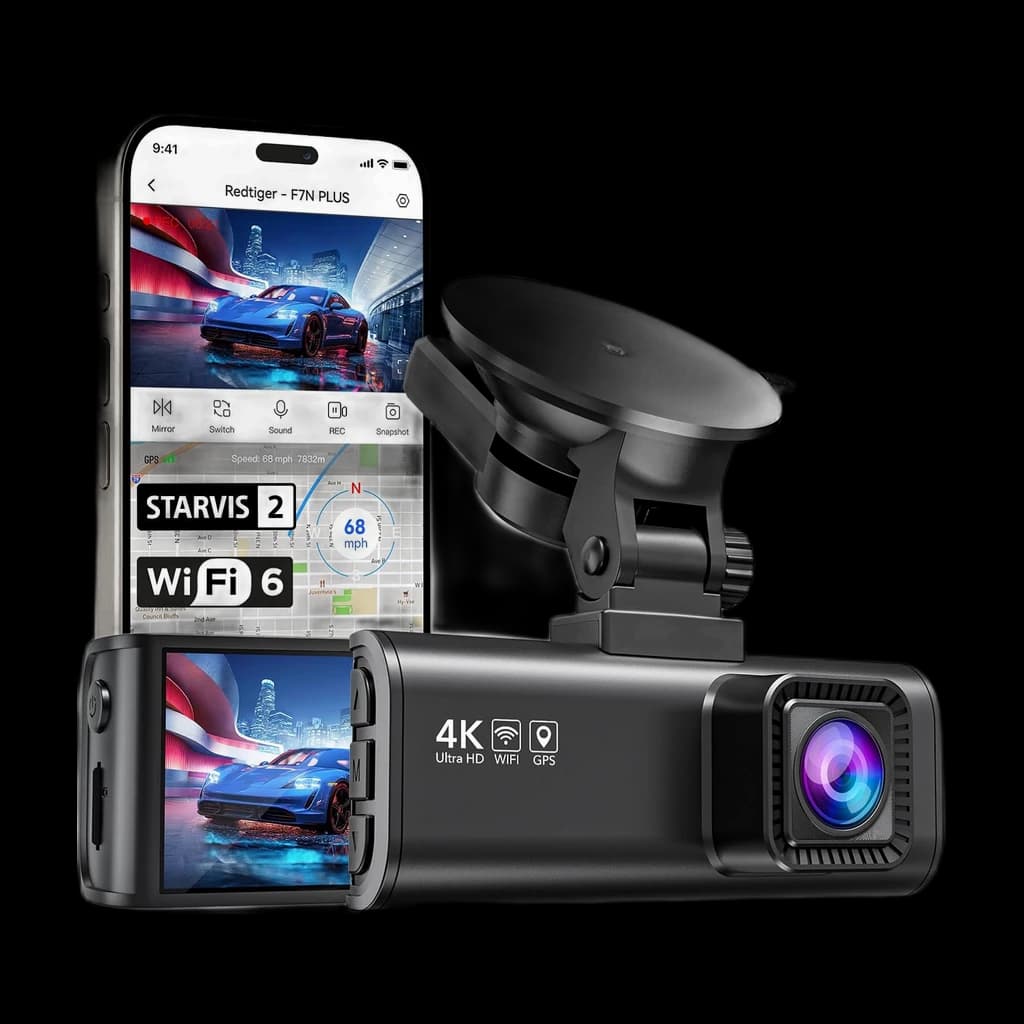
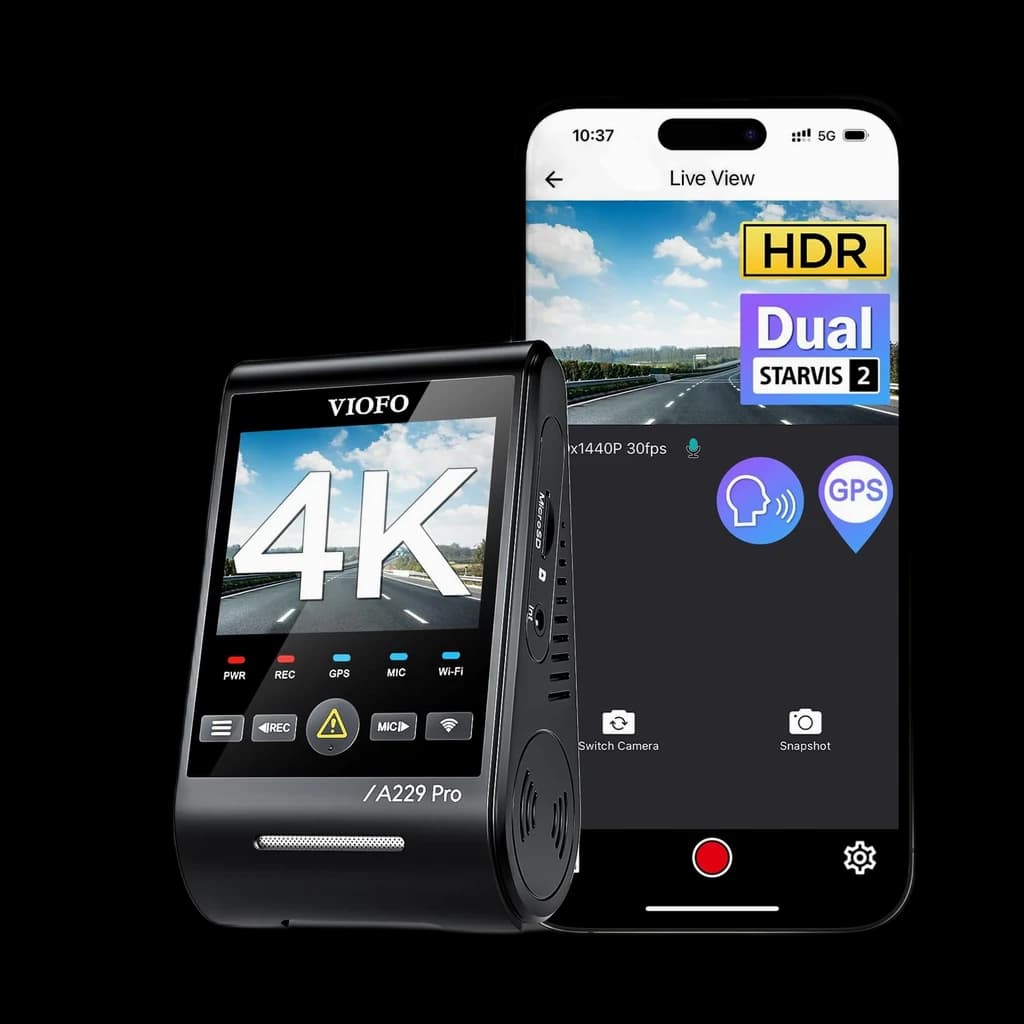
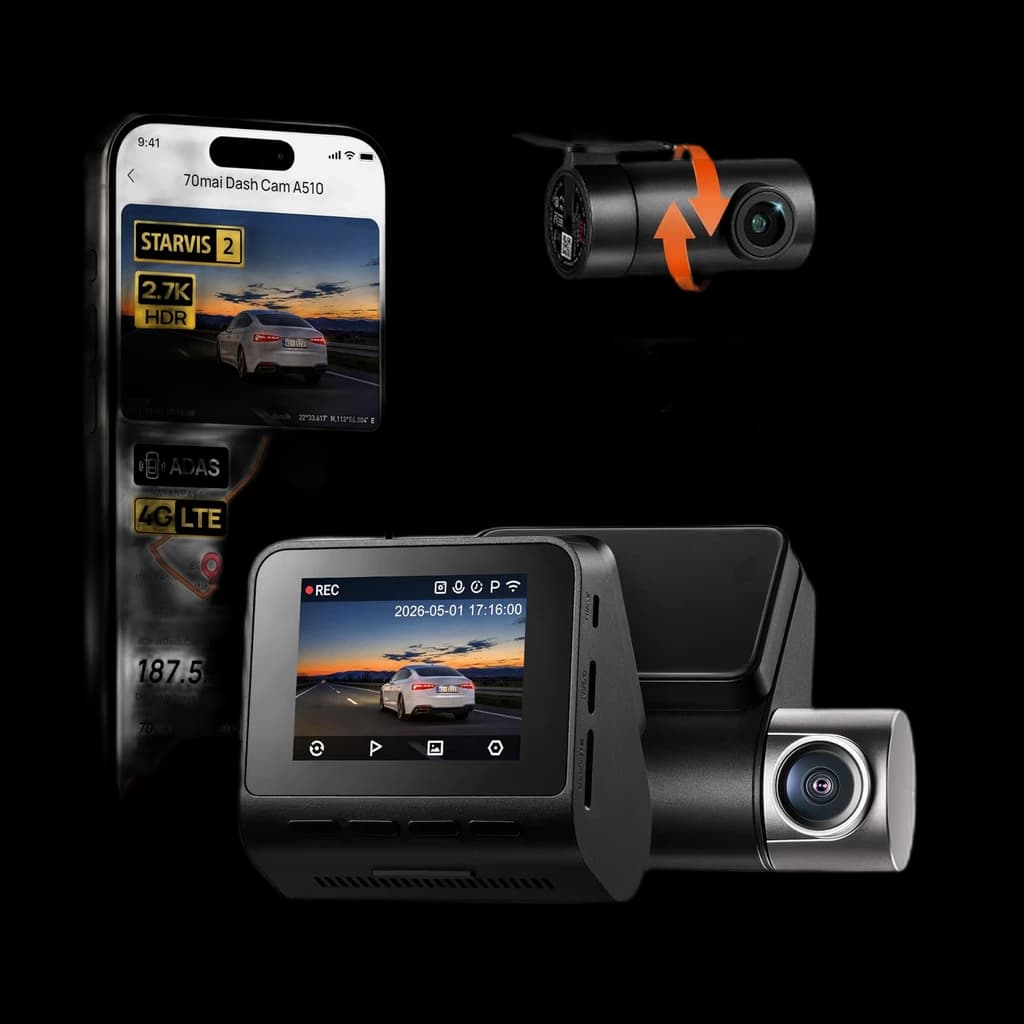
#1REDTIGER F7N — 4K front + 1080P rear 4.4 | #2VIOFO A229 Pro — 3-channel 4K STARVIS 2 4.2 | #370mai A510 — front + rear STARVIS 2 4.5 | |
|---|---|---|---|
 |  |  | |
| DriveScored | |||
| Verdict | The volume best-seller here, with 25k+ ratings: 4K front plus 1080P rear, WiFi and GPS in an affordable bundle. A wide 170° front lens is generous, though that width brings more edge distortion than the tighter VIOFO optics. | The most complete kit we evaluated: VIOFO pairs a 4K front camera on the Sony STARVIS 2 IMX678 with a 2K rear on the STARVIS 2 IMX675 and a 1080P infrared cabin camera, so it covers both roads and the interior at once. Priced and sized for people who actually want three channels, not the casual buyer. | The value pick of the group: 2.7K (1944P) front on a STARVIS 2 IMX675 plus a 1080P rear for $84.99. Built-in GPS and app control that usually cost more, though the bundled 4G LTE features lean on a paid data plan. |
| Price | ~$129.99Buy on Amazon | ~$309.99Buy on Amazon | ~$84.99Buy on Amazon |
| Resolution | 4K front + 1080P rear | 3840x2160 (4K) front + 2K rear + 1080P IR interior | 1944P front + 1080P rear |
| Channels | Front+Rear | 3-channel | Front+Rear |
| Parking Mode | Yes (hardwire) | Yes (hardwire) | Yes (hardwire) |
| Field of View | 170° front | ~140° front | ~140° front |
| Buyer sentiment | Quality Video Quality Installation Value for money Connectivity Durability Buyers praise quality, video quality, installation and value for money. Mixed feedback on reliability. Some flag connectivity and durability. Based on 7,034 user mentions | Quality Video Quality Installation WIFI Connectivity Buyers praise quality, video quality and installation. Mixed feedback on reliability and value for money. Some flag wifi connectivity. Based on 330 user mentions | Quality Video Quality Value for money Ease Of Installation Buyers praise quality, video quality, value for money and ease of installation. Mixed feedback on reliability and connectivity. Based on 814 user mentions |
| Pros |
|
|
|
| Cons |
|
|
|
* Prices are approximate. Click Buy to see current pricing on Amazon.
Which RedTiger the situation actually calls for
| If your situation is… | Pick | Why |
|---|---|---|
| You want the cheapest RedTiger that still records front and rear | The base F7N | It is the only one in the family that ships with both a memory card and a hardwire kit, though its description claims no STARVIS 2 sensor and it is already superseded within its own family. |
| You want the widest front coverage in the family | F7N or F7NP, not the newer F7NA | RedTiger publishes 170 degrees on the F7N and F7NP front lenses and 160 degrees on the F7NA, so the later model narrows the field of view rather than widening it. |
| You want a sensor claim you can check against Sony | F7NA | It is the only F7N-family description that names the Sony part, IMX678; the F7NP, F7N Touch and F7N Elite say STARVIS 2 without naming a part. |
| You want a touchscreen and voice control rather than buttons | F7N Touch, F7N Elite or F7NA | Those three publish touchscreen and voice control; the F7N and F7NP are button-controlled, which is the clearest single difference the suffixes actually encode. |
| Parking mode is the reason you are buying a dash cam | Not the model — the kit, and probably not this brand | Every F7N-series camera uses the same hardwire kit with a fixed cutoff 60 seconds below 11.8 V plus or minus 0.2 V, and no model in the range offers an adjustable threshold. |
| You are buying from RedTiger's own store rather than a retailer | Read the variant selector, not the product name | Seven of the store's dash cam listings are refurbished units carrying names all but identical to the new ones, and one model offers a refurbished option as a variant inside the new listing. |
Each pick is one of the products ranked below - this row is for shortcutting based on your situation, not a separate recommendation.
Type a RedTiger model number into a search box and the results come back as a wall of near-identical listings. The company currently lists twenty different dash cams on its own store, and five of them are some version of the F7N.
The suffixes are not a ladder. We read the product description RedTiger publishes for every camera in the range, mapped what actually changes between them, and found that the specification everyone buys on — 4K — is defined in a footnote at the bottom of every product page, in terms most buyers never read.
The five cameras all called F7N
| Model | Sensor, as the description states it | Front lens | Screen and control | What ships with it |
|---|---|---|---|---|
| F7N (our page) | No STARVIS 2 claim, no Sony part named | 170° | Buttons | 64GB card and a hardwire kit |
| F7NP | "STARVIS 2 sensor", no part named | 170° | Buttons | 128GB card and a hardwire kit on the base bundle |
| F7N Touch | STARVIS 2, no part named | 170° | Touchscreen and voice | 128GB card; hardwire kit stated as separate |
| F7N Elite | STARVIS 2, no part named | Not stated in the description | Touchscreen and voice, Wi-Fi 6 | Hardwire kit |
| F7NA | STARVIS 2 IMX678, named | 160° | Touchscreen and voice | No card, no hardwire kit |
Read the last two columns together and the ladder falls apart. The F7NA is the only F7N-family camera whose description names the actual Sony sensor part, which is the strongest evidence in the range — and it is also the one with the narrowest front lens and the emptiest box.
The P does not stand for GPS, which is the most common guess. Every camera in that table logs GPS, including the base F7N. What the P actually adds, on the page RedTiger publishes, is the STARVIS 2 claim and a 5.8GHz radio.
What a suffix reliably tells you:
- Whether there is a touchscreen and voice control instead of buttons.
- Roughly what is in the box — card, hardwire kit, extension cable.
- Which accessory family the camera belongs to, which decides which CPL filter and extension cable fit.
What it does not tell you:
- Which sensor is inside, unless the description names a part number.
- Whether the front lens is wider or narrower than the cheaper model's.
- Whether parking mode behaves differently, because it does not.
The footnote at the bottom of every product page
RedTiger defines 4K on its own product pages, in small type under the comparison block. The definition is about the exported video file — no less than 3840 × 2160 — rather than about what the sensor captures. It appears identically on the F7N, F7NP, F7NA and F17 pages.
Read the footnote: the number on the box describes the file the camera writes, not the sensor that fed it.
That distinction is why a resolution figure alone cannot separate two cameras in this range, and why the sensor column above does more work than the 4K badge does.
A claim and a part number are different things
We counted what the descriptions actually commit to, across all twenty current models.
| What RedTiger's own description states | Models, out of 20 |
|---|---|
| Advertises 4K somewhere in the description | 15 |
| Claims a Sony STARVIS 2 sensor | 10 |
| Names the Sony part number (IMX678 or IMX675) | 5 |
| Claims STARVIS 2 but names no part | 5 |
A named part is checkable against Sony. A brand-family name is a claim about a family that spans many parts. Half the STARVIS 2 claims in this range are the second kind, and three of those five are F7N variants.

Parking mode is the one thing that does not change
This is where the model-by-model shopping stops mattering. RedTiger publishes one hardwire kit specification across the F7N series, and it is fixed:
- Power cuts 60 seconds after the supply falls below 11.8 V, plus or minus 0.2 V. There is no switch — what that threshold means on a battery chart is the part worth reading before you fit one.
- Input is rated 12 V to 24 V, and RedTiger states the kit is not for vehicles running above 24 V.
- Over-current, short-circuit, reverse-connection and overheat protection are on the kit, not on the camera.
- The kit is not in every box. Two of the five F7N-family cameras state it separately.
Rule of thumb: on this range, choose the model for its screen and its box, then budget for parking power as a separate purchase with its own fixed specification.
The listings that look like the camera you wanted
Seven of the dash cam listings in RedTiger's own store are refurbished units, and they carry names all but identical to the new ones — an F7N, an F7NP, an F7N Elite, an F17 Elite, a T27, an F9 and an A4, each with a refurbished tag at the end of a long title. One 4K model sells a refurbished option as a variant inside the same listing as the new units.
We do not link refurbished listings anywhere on this site. If you are buying from the official store, read the variant selector, not the product name.
Where this range honestly sits
The one RedTiger camera we rank is the F7N, and its page already carries a superseded note: the family moved on and the F7N is the old base model still being sold. That is the honest position for the whole range — high volume, aggressive pricing, and a naming system that makes generation-checking harder than it should be. The comparison table near the top of this page sets the F7N beside the two front-and-rear cameras we rank above it, the VIOFO A229 Pro and the 70mai A510, both of which name a Sony STARVIS 2 part on their makers' pages.
Buy something else if:
- You want a published, adjustable low-voltage cutoff. Only the parking-power comparison shows which brands offer one, and RedTiger is not among them.
- You want a third channel or an interior camera you can verify by part number. Our three-channel pick names its sensor.
- Long-term reliability matters more than price. See what the dash cam category actually rewards, and whether you need a rear camera at all before you spend on one.
Buy a RedTiger if the box contents and the screen are what you are actually shopping for, and if you have read the sensor row rather than the title.
Your next step
Compare RedTiger's position with the full ranked dash-cam shortlist.
Common questions
What is the difference between the RedTiger F7N and the F7NP?
Is the RedTiger F7NA an upgrade over the F7NP?
Do RedTiger dash cams really record in 4K?
Which hardwire kit works with a RedTiger dash cam?
Why do RedTiger listings look almost identical to each other?
Research Sources
- REDTIGER official store — dash cam collection listing all current models, with the per-model product descriptions used for the sensor, lens-angle and box-contents comparison in this article
- REDTIGER F7NP product page — STARVIS 2 sensor claim without a part number, 170 degree front and 140 degree rear lenses, 5.8GHz WiFi, GPS, supercapacitor, and the site-wide footnote defining 4K as the exported file resolution of no less than 3840 x 2160
- REDTIGER F7NA product page — the only F7N-family description naming the Sony part (STARVIS 2 IMX678), with the 160 degree front and 140 degree rear lens angles and the statement that no SD card or hardwire kit is included
- REDTIGER F7N product page — base model description with GPS, 170 degree wide angle, included 64GB card and hardwire kit, and no STARVIS 2 claim
- REDTIGER F7N hardwire kit product page — low voltage protection cutting power 60 seconds below 11.8 V (plus or minus 0.2 V), 12 V to 24 V input, the statement that it is not applicable to vehicles above 24 V, and over-current, short-circuit, reverse-connection and overheat protection
- r/Dashcam — Thoughts on Redtiger cameras: the community thread whose paraphrased consensus on spec scepticism, reliability reports and hardwire-kit voltage settings is summarised in this article