Quick Answer
Work from easiest to most accurate. First remove the surface charge, either by running the headlights for a couple of minutes, as Interstate describes, or by letting the battery sit for hours, then read resting voltage with a multimeter on DC volts. On Interstate's chart, 12.88 volts is 100 percent, 12.39 volts is 50 percent and 11.80 volts is empty, and VARTA says to recharge below 12.4 volts. Second, watch the minimum voltage while a helper cranks the engine. Third, because voltage shows charge rather than health, charge the battery fully and get a conductance or load test, which Optima says most auto parts stores will do free, with the tester set to your battery type and CCA rating.
Key takeaways
- A multimeter measures charge, not health. Interstate says a battery can be 75 or 100 percent charged and still close to failing, and only a conductance or load test measures health.
- Remove the surface charge first. Right after driving or charging a battery reads artificially high, so run the headlights for a couple of minutes or let it rest for hours before you read it.
- On Interstate's chart a rested battery at 12.88 volts is full, 12.39 volts is half and 11.80 volts is empty. VARTA says to recharge below 12.4 volts.
- Voltage charts disagree between brands and Interstate's does not separate flooded from AGM, so use one maker's chart rather than mixing figures.
- A shop tester is only as good as its setup. VARTA says it must be set to the right battery type and given the CCA rating and its standard from the label.
- Low cranking amps can come from stratification after low charge or underuse, which Midtronics says is reversible in many cases, so charge and retest before replacing.

NOCO GENIUS10 — 10A smart charger & maintainer
- 10A output suits trucks, RV house banks, and deep-cycle batteries
- Full multi-chemistry support including a lithium (LiFePO4) mode
- Repair/desulfation and force mode for recovering dead batteries
Researched as the pick for larger and dual batteries: 10A recharges trucks, RVs, boats, and deep-cycle banks roughly twice as fast as the GENIUS5. It keeps the same multi-chemistry detection, lithium profile, and repair mode, so you only step up if you genuinely need the amps.
What your result means, and what to do next
| If your situation is… | Pick | Why |
|---|---|---|
| Rested reading of 12.6 volts or more, but the engine cranks slowly | Get a conductance or load test | Voltage shows charge only. Midtronics notes a battery can read 12.6 volts fully charged with severely weakened internal conductance, and Interstate calls a conductance tester the most accurate battery test. |
| Rested reading below 12.4 volts | Charge fully, let it rest, then read again | VARTA says a conventional battery below 12.4 volts should be recharged as soon as possible, and Optima says low voltage alone does not make a battery bad, especially in a modern car that has sat unused. |
| Reads full after charging, then low again within hours | Have it tested before you trust it | Interstate describes exactly this pattern in a weak battery: it can read 100 percent right after charging, then the voltage drops again in a few hours. |
| Tester reports cold cranking amps below the rating | Recharge and retest, then replace if it is still short | Midtronics says low CCA is mainly caused by stratification, which is reversible in many cases. If measured CCA is still below what the engine needs, Interstate says charging will not fix it. |
| Cracked, leaking or bulging case | Stop testing and replace the battery | Midtronics says a bulging case is almost always a sign the battery needs changing, and Trojan Battery's inspection routine checks for cracks and says leaking batteries must be repaired or replaced. That is shop work, not a driveway test. |
| Start-stop car that auto-stops less often than it used to | Test with a tester set for AGM or EFB | VARTA says most testers judge an AGM or EFB battery's capacity and charge acceptance only indirectly, and reads fewer start-stop events as the battery management system protecting a battery due for replacement. |
Use this row to shortcut by situation.
Drive home, touch a meter to the terminals, and the number often looks like a healthy battery. Much of that is leftover charge from the alternator. Testing at home is less about the meter than about when you read it, and which of three tests you run.
Three tests, three different questions
| Test | Tool | What it answers | What it cannot tell you |
|---|---|---|---|
| Resting voltage | Multimeter | How charged the battery is | Whether it can still deliver starting current |
| Cranking watch | Multimeter with MIN/MAX | How far voltage sags during one start | A pass or fail on its own |
| Conductance or load test | Battery tester, usually at a shop | Health against the battery's rating | Much, if it is set to the wrong battery type |
Interstate Batteries puts it bluntly: a battery can be 75 or 100 percent charged and still be at death's door. The multimeter is your first step, not your verdict. This guide covers 12-volt lead-acid starting batteries, not hybrid or EV high-voltage packs.
Our pick
NOCO GENIUS10 — 10A smart charger & maintainer
Before you touch the terminals
- Work outdoors or somewhere well ventilated. Fluke warns that lead-acid batteries can emit explosive gas and contain acid.
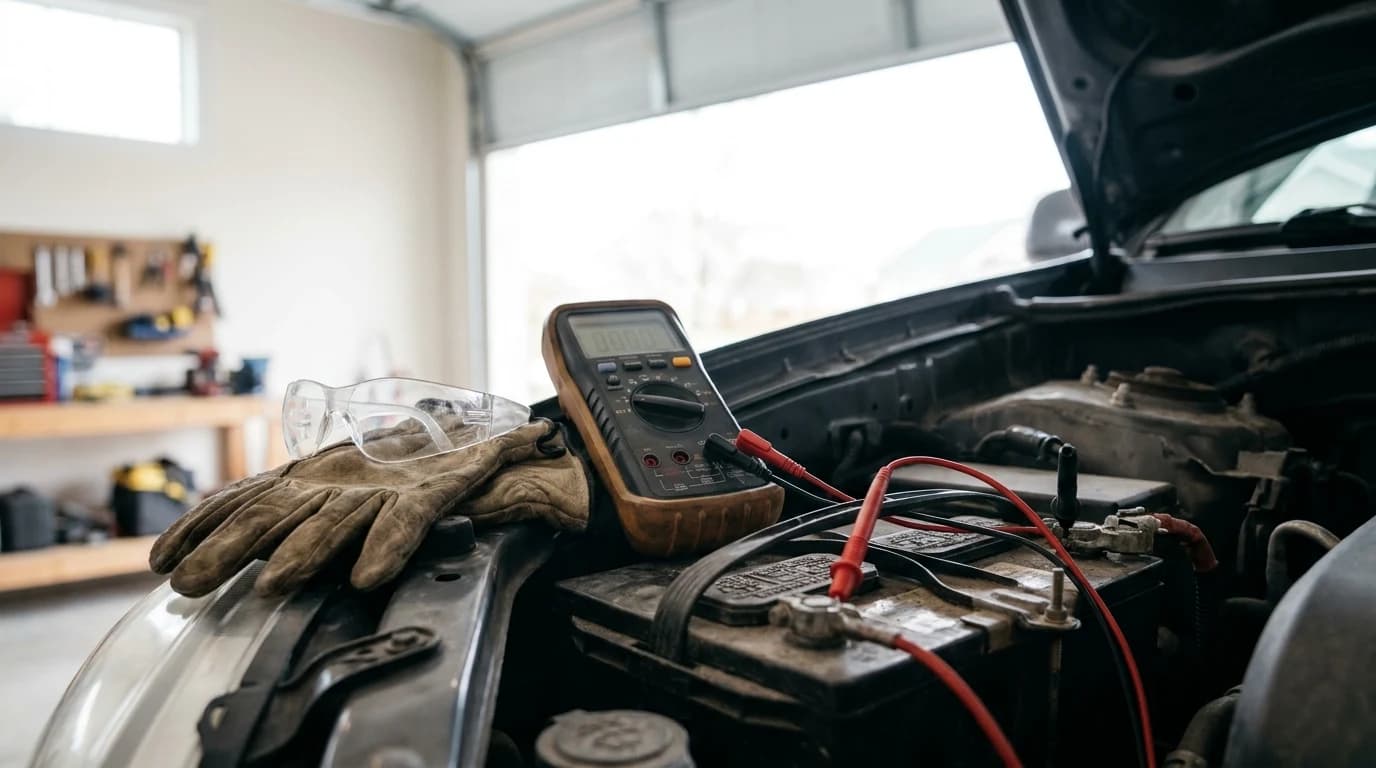
- Take off jewelry and put on gloves and safety glasses, as Interstate's charging guide instructs.
- Check the case. Trojan Battery's inspection routine looks for cracks and leaks, and Midtronics says a bulging case almost always means replacement. Find any of these and stop.
- Keep hands and leads clear of fan belts and moving parts.
- Photograph the label: the battery type and cold cranking amp (CCA) rating matter in Test 3.
Test 1: resting voltage with a multimeter
Step 1: Get rid of the surface charge
The surface-charge trap. Right after driving or charging, a battery reads artificially high. Interstate calls this surface charge, and it flatters any chart you compare against.
- The quick way. Interstate says to run the headlights for a couple of minutes, then switch them off before measuring. Fluke suggests about a minute, and VARTA switches on a load such as the headlights shortly before a tester measurement for the same reason.
- The patient way. Let the battery sit. Trojan, writing about its own batteries, asks for at least 6 hours idle, preferably 24, before an open-circuit voltage reading.
Waiting catches a second trap: Interstate notes a weak battery can look full right after charging, then lose voltage within hours.
Step 2: Set up the meter
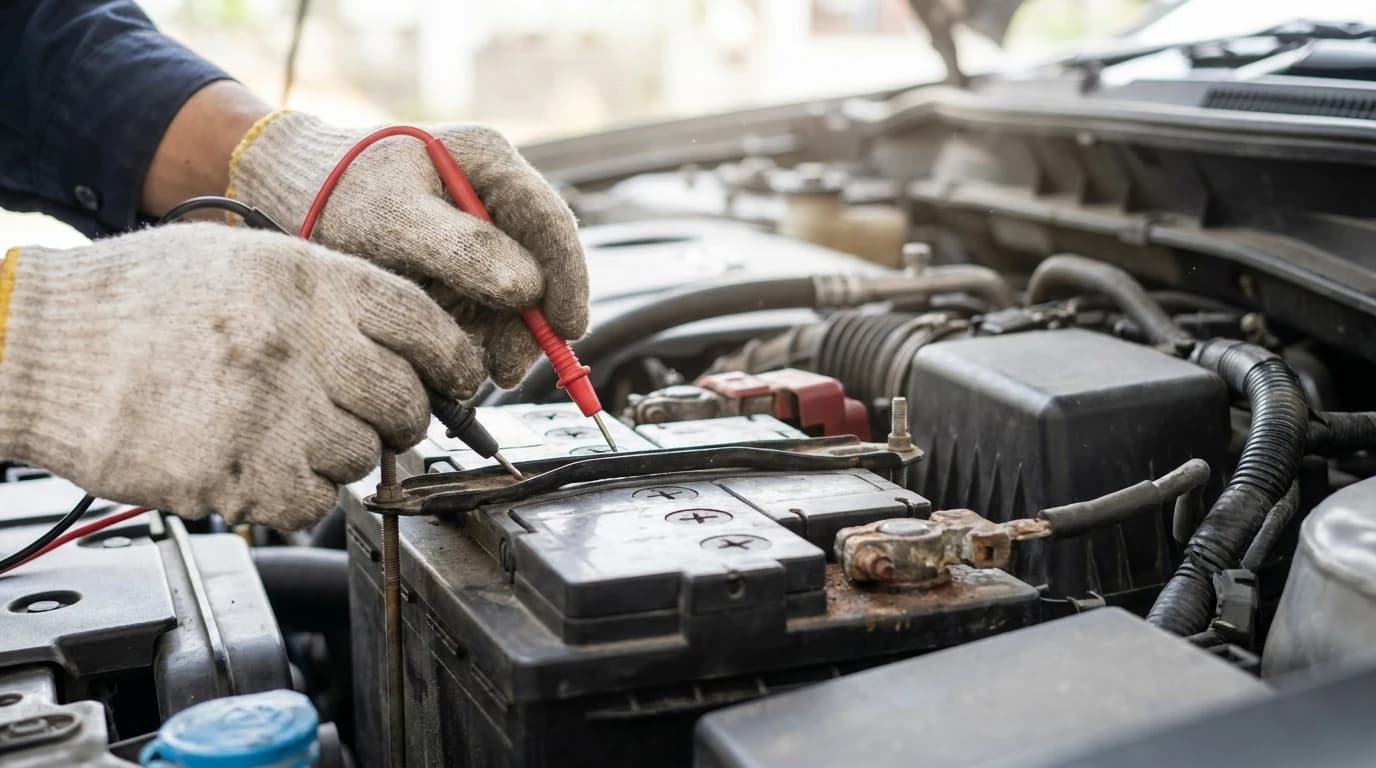
Black lead in COM, red lead in the volts jack, dial on DC volts, per Fluke's multimeter guide. If it asks for a range, Interstate says to pick one above 15 volts. Engine and accessories off.
Step 3: Take the reading
Red to positive, black to negative. Write down the number and when the car was last driven or charged.
Reading the car battery voltage chart
This is Interstate's published chart for a rested battery, from its battery-test guide:
| Resting voltage | State of charge (Interstate) |
|---|---|
| 12.88 V | 100% |
| 12.64 V | 75% |
| 12.39 V | 50% |
| 12.09 V | 25% |
| 11.80 V | 0% |
Before you lean on it:
- Full to empty spans about one volt. Hundredths matter, and so does surface charge.
- Charts do not agree. Fluke's guide calls about 12.4 volts roughly 75 percent charged; on Interstate's chart, 12.39 volts is half. VARTA calls about 12.8 volts ideal for a conventional battery and says to recharge below 12.4 volts. Use one maker's chart, ideally your battery maker's, and never blend them.
- It does not split flooded from AGM. None of the battery-maker pages behind this guide publishes separate flooded and AGM figures, so neither does this chart. Designs do differ: Optima puts most full car batteries at 12.6 volts or more, but its YELLOWTOP line near 13.0 to 13.2 volts.
A good number proves charge, not health. Midtronics, which makes battery testers, notes that a battery can read 12.6 volts fully charged and still have severely weakened internal conductance. Only Test 3 measures that.
Test 2: watch the voltage while it cranks
Fluke recommends the meter's MIN/MAX function to catch voltage drops when the engine starts.
- Hold or clip the leads on the terminals, clear of the belts, with MIN/MAX on.
- Have a helper start the engine once.
- Read the minimum the meter captured and note the outside temperature.
No battery maker we found publishes a universal pass figure, so treat the result as a baseline to repeat and show a shop. Midtronics explains the limit: starting is a short, high-current event that does not reveal internal degradation or reserve capacity, and a warm battery performs better under load than a cold one.
Test 3: a conductance or load test
This is the test that decides replacement. Interstate describes two kinds. A conductance tester sends a signal through the battery and measures how well it conducts; Interstate calls it the most accurate. A load tester draws power instead, and a few in a row can drain a battery flat. If the measured cold cranking amps fall short of what the engine needs, Interstate says no amount of charging will fix it.
Optima says to charge the battery fully first, then have it load-tested, which most auto parts stores will do free. Check the setup against VARTA's testing procedure:
- Right battery type. Conventional starter, EFB, AGM and gel batteries each get a different test algorithm, so a wrong setting gives a wrong result.
- Right rating. The CCA from your label goes in with its standard, such as SAE, EN, DIN, IEC or JIS.
- Right connection. A battery in the trunk or cabin gets clamped at its own terminals, not the jump posts under the hood, whose cable resistance skews the measurement.
Start-stop cars need extra care. VARTA says most testers measure only CCA and judge an AGM or EFB battery's remaining capacity and charge acceptance only indirectly and imprecisely, so a "Battery OK" can mislead. Fewer auto-stops than before, VARTA says, is the battery management system protecting a battery due for replacement.
Charge it or replace it
Two findings change what you do next:
- Low CCA is not always a dead battery. Midtronics says the main cause of low cranking amps is stratification, acid settling after low charge or underuse, and that it is reversible in many cases once the charge is replenished. Charge and retest before you buy.
- A very flat battery can confuse a charger. Optima notes that some chargers will not recognise a battery discharged below a minimum voltage, sometimes as high as 10.5 volts.
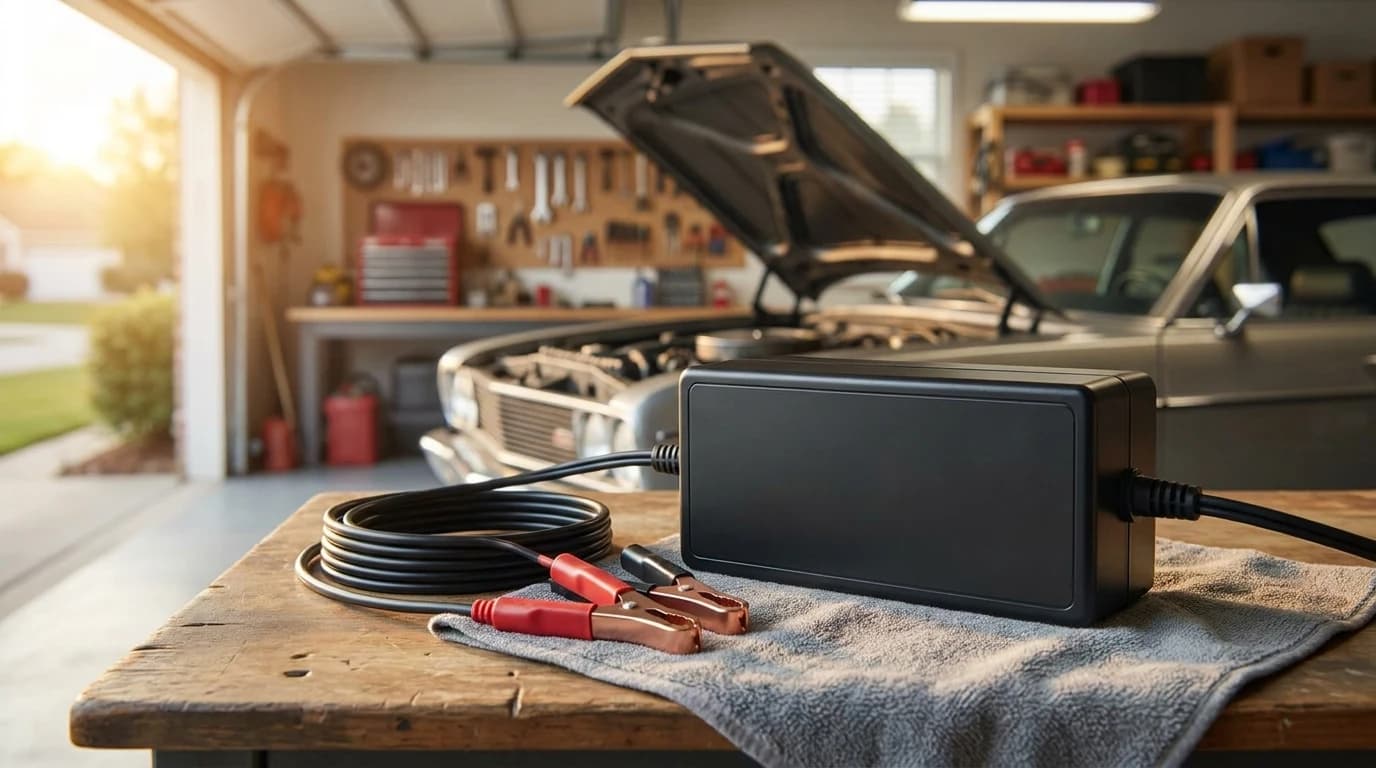
For the recharge, the NOCO GENIUS10 is the top pick in our chargers and maintainers category, with repair and force modes for a deeply flat battery. The Schumacher SC1281 adds a 100-amp engine-start mode, and the Battery Tender Junior 021-0123 is a 0.75-amp maintainer for a car that sits.
Our guide to charging a car battery covers amps, modes and connection order, and how long car batteries last explains when age and climate make replacement likely anyway.
Common questions
What voltage means a car battery is bad?
Can a car battery read 12.6 volts and still be bad?
How long should a car battery sit before testing the voltage?
Can I test an AGM battery with a multimeter?
Is a free auto parts store battery test worth getting?
Research Sources
- VARTA Automotive — Testing the battery, step-by-step
- VARTA Automotive — Interpretation of battery tests
- Interstate Batteries — When Your Car Battery is at Death's Door (battery testing and voltage chart)
- Interstate Batteries — How To Charge Your Car Battery (safety steps)
- Trojan Battery — Battery Maintenance (inspection and open-circuit voltage test)
- OPTIMA Batteries — What Voltage is Considered Bad for a Car Battery?
- Midtronics — Top 3 Misconceptions in Battery Diagnostics
- Fluke — How to Measure Battery Voltage with a Multimeter