Quick Answer
Match three specifications, in this order. First the amp-hour range: a charger is rated for a band of battery sizes, and Battery Tender's own page puts the Junior at 3 to 30 Ah and tells you to move up to the Plus above that, while NOCO's GENIUS10 is rated to 230 Ah. Second the mode: the chemistry button is a voltage selector, and on the GENIUS10 the plain 12V setting targets 14.5V against 14.8V for AGM and 14.6V for lithium. Third the current, which only sets how long it takes; NOCO's own table gives seven hours for a 100 Ah battery at 10 amps, from half discharged rather than flat. Connect red to the positive terminal, black to bare engine metal or the chassis away from the battery, then plug the charger into the wall last. Never charge a frozen or physically damaged battery.
Key takeaways
- Amp-hours, not amps, decide whether a charger suits your battery. Battery Tender specifies the Junior for 3 to 30 Ah batteries and directs anything larger to the Plus, so a maintainer that appears on car-charger lists is scoped by its maker to powersports and small-vehicle batteries.
- The chemistry mode is a target voltage. NOCO publishes 14.5V for standard 12V lead-acid, 14.8V for AGM and 14.6V for lithium on the GENIUS10; CTEK publishes 14.4V, 14.7V and 15.8V for normal, AGM and recondition on the MXS 5.0. Lithium sits below AGM, so the intuitive ranking is wrong.
- NOCO's charger manual sends the black clamp to the chassis or engine block away from the battery, while NOCO's own jump-pack manual lists the negative battery terminal first. A mains charger is live at its clamps; the pack withholds output until it detects a battery.
- Force mode and 13.6V Supply both disable the charger's safety features by NOCO's own description, and the 12V Repair mode drives up to 16.5V. Those are the three settings not to press experimentally.
- Both makers publish a stopping point. CTEK says a charger that has not reached STEP 7 within 50 hours is signalling an error; NOCO's Bad Battery LED means the battery will not hold a charge and needs professional testing.
Which charger the situation actually calls for
| If your situation is… | Pick | Why |
|---|---|---|
| A daily driver's battery that went flat once and you want it properly refilled | A multi-amp smart charger rated well above your battery's amp-hours | NOCO's published table puts a 100 Ah battery at seven hours on 10 amps from a 50% discharge, so current is what turns an overnight job into a weekend one. |
| A motorcycle, mower or classic that sits for months between uses | A low-current maintainer sized to that battery's amp-hour range | Battery Tender scopes the Junior to 3 to 30 Ah batteries and describes float maintenance as offsetting self-discharge, which is the job a parked battery actually needs. |
| The battery is an AGM, or a lithium replacement with a BMS | A charger with an explicit mode for that chemistry, and press it | The mode changes the target voltage by a few tenths of a volt, and the manuals set different values for AGM and lithium rather than one universal 12V profile. |
| The charger will not start because the battery reads too low to detect | Treat force-start as a last resort, not a workaround | NOCO states that Force mode disables the safety features and leaves live power at the connectors, which is exactly the protection a smart charger was bought for. |
| Two days on the charger and it still has not reported a full charge | Stop and have the battery tested | CTEK treats a charger that has not reached STEP 7 within 50 hours as an error condition, and NOCO's Bad Battery indicator says the same thing in one LED. |
| The battery is frozen, swollen, split or leaking | Do not charge it at all | Every manual in this category carries the same instruction, and it is the one warning on which no two makers disagree. |
Use this row to shortcut by situation.
A jump start gets the engine running. It does not put the charge back — that is a different appliance, and the charger aisle sells it on one number.
Amps is the wrong number to lead with. We read the published manuals for the chargers this site lists, and three specifications do all the work. Only one of the three is printed large on the box.
Amps buy hours, and nothing else
NOCO publishes a charging-time table inside the GENIUS10 user guide, and it is unusually candid about its own assumptions. Every figure below is from a 50% depth of discharge — half empty, not flat.
| Battery size | Approximate time to charge at 10 A |
|---|---|
| 20 Ah | 1.5 hours |
| 40 Ah | 3.0 hours |
| 80 Ah | 6.0 hours |
| 100 Ah | 7.0 hours |
| 230 Ah | 17.3 hours |
Scale that down and the aisle makes sense. The same half-discharged battery a 10-amp charger fills before breakfast takes most of a long weekend on a one-amp maintainer. Current is the entire variable. NOCO's own caveat — the times are for reference only, and battery condition and temperature both move them — makes the table a floor rather than a promise.
The reframe: a maintainer and a charger are not the same appliance in two sizes. One is sized to replace what a parked battery loses on its own. The other is sized to refill one that has been emptied.
Amp-hours decide whether it fits at all
This is the specification the roundups skip, and it is the one that disqualifies products.
Battery Tender's own page for the Junior — a fixture on best-car-battery-charger lists, and a unit we list ourselves — puts its range at 3 Ah to 30 Ah, describes it as purpose-built for powersports and small-vehicle batteries, and then says plainly that for batteries larger than 30 Ah the bigger Plus is the correct choice.
| Charger | Charging current | Rated battery size |
|---|---|---|
| NOCO GENIUS10 | 10 A | Up to 230 Ah; maintains all sizes |
| CTEK MXS 5.0 | 5 A max | 1.2–110 Ah; up to 160 Ah for maintenance |
| Battery Tender Junior | 750 mA | 3–30 Ah |
Read that right-hand column before the price. A unit rated to 30 Ah is not a small car-battery charger — it is a different appliance for a different battery, and its maker says so on its own product page.
The mode button is a voltage selector
Chemistry modes look like a compatibility list. They are a set of target voltages, and the gaps are narrow enough that nobody guesses them correctly. NOCO adds a footnote most readers skip: these are peak voltages measured at 25 °C, and the amperage figure is bulk amperage above 0 °C, so a cold garage moves both numbers.
| Setting | GENIUS10 | MXS 5.0 manual |
|---|---|---|
| Standard 12 V lead-acid | 14.5 V | 14.4 V |
| AGM | 14.8 V | 14.7 V |
| Lithium (LiFePO4) | 14.6 V | not offered |
| Recovery / recondition | up to 16.5 V | 15.8 V |
Two things worth noticing. On one charger, the difference between the plain 12 V setting and the AGM setting is three tenths of a volt — which is the whole reason an AGM mode exists, and the whole cost of forgetting to press it. And NOCO's lithium mode sits below its AGM mode, so "newer chemistry, higher voltage" is not the rule people assume it is.
Rule of thumb: amps decide when you get the car back. The mode decides whether the battery ends up genuinely full.
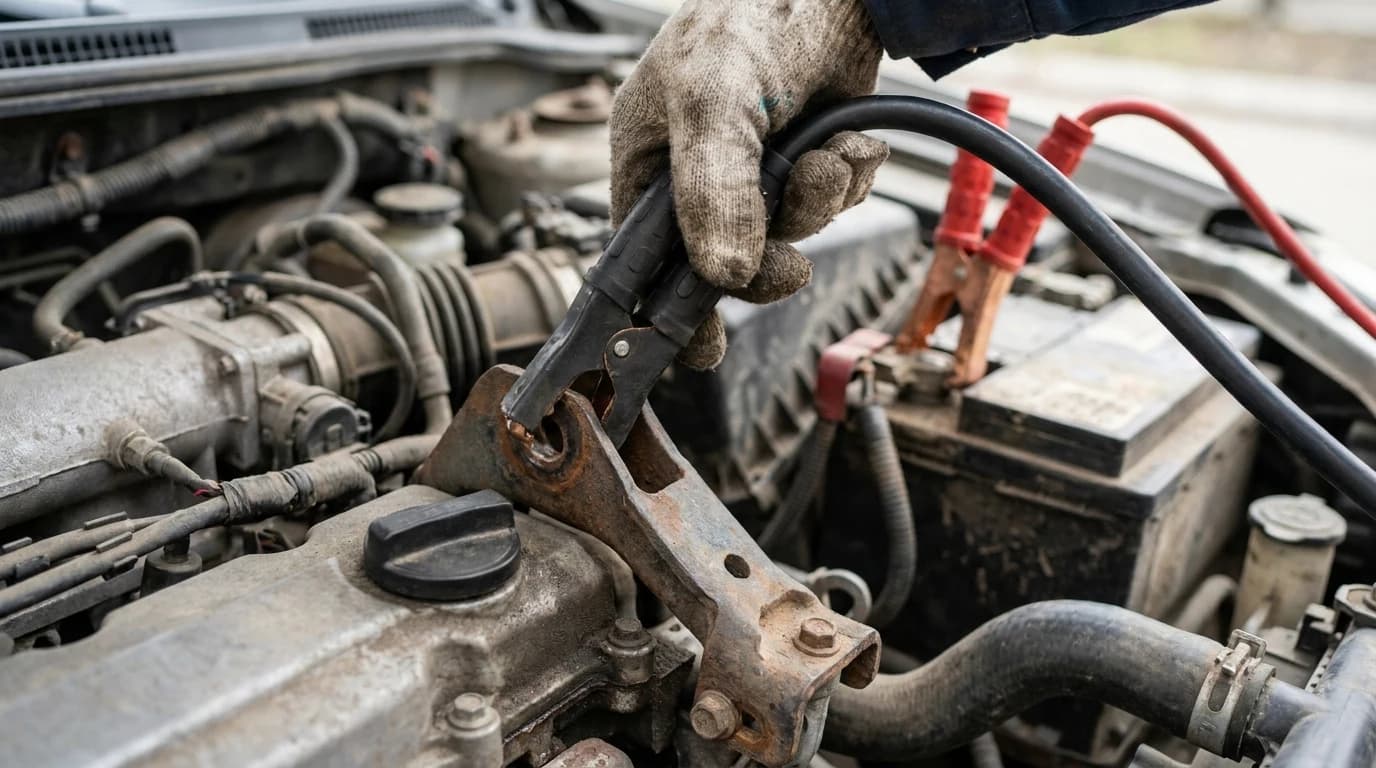
Where the black clamp goes — and why one brand gives two answers
NOCO's charger manual and NOCO's jump-pack manual do not agree, and both are right.
- GENIUS10, battery in the vehicle: red to the ungrounded positive terminal, then black to the vehicle chassis or engine block away from the battery — a heavy-gauge part of the frame or engine. Plug the charger into the wall last, and do not face the battery while you do it.
- Boost GB40 jump pack: black to the negative terminal or the chassis. The pack's manual lists the battery post first.
The difference is when current is present. A mains charger is a live source at its clamps the moment it is powered; the pack withholds output until it detects a correctly connected battery. It is the same distinction we found running through the jump-start procedures, and it means a habit learned from a jump pack is the wrong habit at the wall.
Two modes that switch the safety features off
Smart chargers are bought for their protections. Two settings on the GENIUS10 turn those protections off, and the manual says so in capitals. A third is high-voltage by design.
- Force mode, for batteries that read below 1 V and cannot be detected: NOCO warns it "disables safety features and live power is present at the connectors," and it runs for five minutes before normal detection resumes.
- 13.6 V Supply, which converts the charger into a DC power supply for a memory keeper or a tire inflator: the same warning, verbatim.
- 12 V Repair, the desulfation mode, drives up to 16.5 V into the battery. NOCO says it may cause water loss in flooded cells and advises disconnecting the battery from the vehicle first, because some electronics are sensitive to high charging voltage.
None of that makes the modes unusable. It makes them the three you should not press to see what happens.
When to stop charging and start testing
Both makers publish a point at which the charger has already told you the battery is finished, and neither number is well known.
CTEK's manual is the blunter of the two: check that the charger has reached STEP 7 before leaving it unattended for long periods, and if it has not switched to STEP 7 within 50 hours, treat that as an error and disconnect it manually. NOCO's equivalent is an LED — a solid Bad Battery light meaning a possible short, or a battery that will not hold a charge, with the instruction to have it checked professionally.
The two also split on repair. Battery Tender states that once sulfation has formed to any significant degree it cannot be dissolved or reversed by any charger. NOCO sells a mode aimed at exactly that job and hedges it in the same manual — not all batteries can be recovered. Where they do not disagree at all: never charge a frozen battery, and never charge a damaged one. Those two warnings are identical across every manual in this category, which is usually a sign the failure behind them is real.
What both makers agree on: prevention. Keeping a parked battery topped up avoids the condition neither of them promises to reverse.
Your next step
Match charger amperage and chemistry to the battery and the job.
Common questions
How long does it take to charge a car battery?
Can I use a Battery Tender Junior on my car?
Does the AGM setting on a battery charger really matter?
Where do you connect the negative clamp of a battery charger?
Can a charger fix a sulfated battery?
Research Sources
- NOCO GENIUS10 User Guide (rev. 04.09.2024) — charge-mode voltages, charging-time table, connection sequence, and the Force / Supply / Repair cautions
- Battery Tender Junior 12V 750mA (021-0123), Deltran product page — 3–30 Ah rated range and the maker's own instruction to step up to the Plus above 30 Ah
- CTEK MXS 5.0 user manual (doc. 20017986A) — technical specification: 14.4V / 14.7V / 15.8V charging voltages, 5A max, 1.2–110 Ah, and the 50-hour STEP 7 rule
- NOCO Boost GB40 User Guide (rev. 03.07.2025) — jump-pack clamp sequence permitting the negative battery terminal or the vehicle chassis